
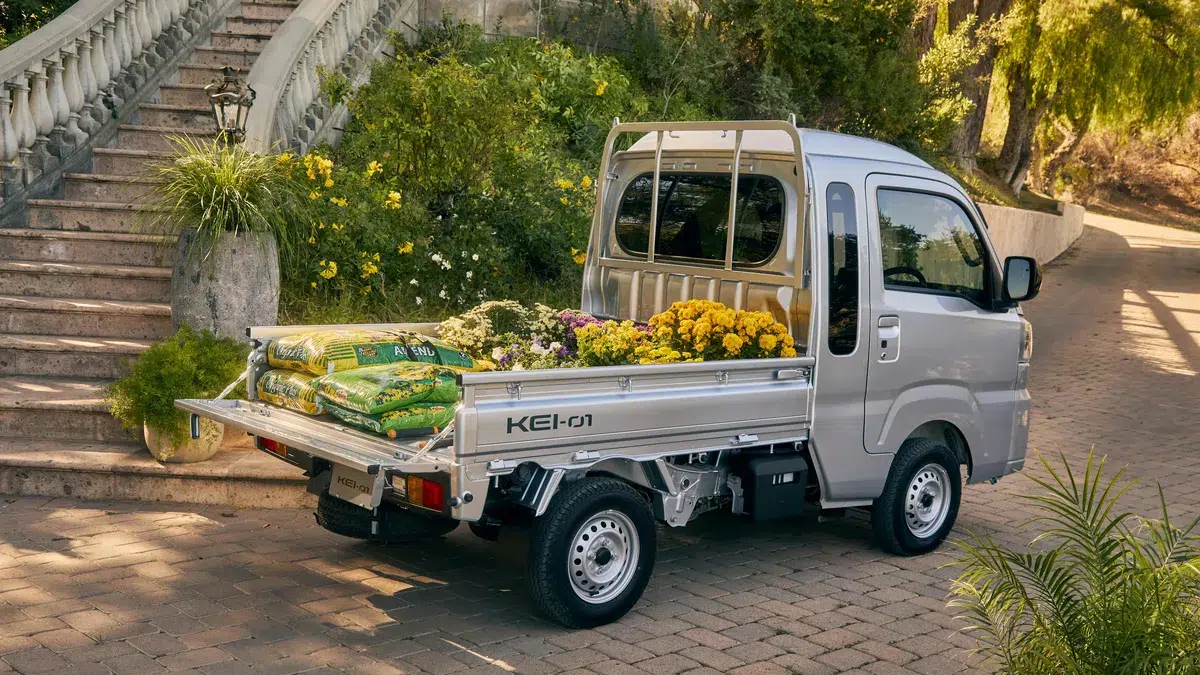

Toyota has brought back Scion, and the first thing wearing the badge isn’t a sports coupe. It’s a kei truck.
The Scion KEI-01 was revealed in the US this week: a tiny right-hand-drive work ute with a 660cc three-cylinder, a CVT and selectable four-wheel drive. Toyota calls it “an intentionally low-volume, niche vehicle”, and it will be assembled at Toyota’s Indiana plant from the second half of 2027.
It isn’t coming to Australia. But if a kei truck is what you’re after, there’s already a way to get one here, and it doesn’t involve waiting for Toyota.
What Toyota actually announced
- Engine: 660cc three-cylinder with a CVT
- Drive: selectable 4WD with an auto mode and a push-button lock
- Payload: up to 600lb (about 272kg), on a tray that folds down on three sides
- Size: just over 11 feet long and under 5 feet wide (roughly 3.4m by 1.5m)
- Cabin: extended cab with a raised roof, sliding and reclining seats, heating and air-con
- Top speed: 25mph, which is about 40km/h
Toyota hasn’t published power, torque, weight or a price. It also doesn’t say what the KEI-01 is based on, though Jalopnik reports it’s the truck sold in Japan as the Toyota Pixis and Daihatsu Hijet.
It starts as a fleet trial, aimed at farms, councils, university campuses and small businesses through selected Toyota dealers. Toyota says it may consider limited retail sales later.
Why it isn’t coming here
The KEI-01 is built for one market. Toyota designed it to meet the US rules for low-speed vehicles, which is where that 25mph limit comes from, and its announcement doesn’t mention any other country. A work ute that tops out at 40km/h would struggle on most Australian roads anyway.
The truck underneath it is a different story.
Can you import a kei truck to Australia?
Yes, once it’s old enough. The federal older vehicle concession lets you import a vehicle whose build date is at least 25 years before the day you apply. It covers goods vehicles as well as cars, so the same rule that brings in a Skyline brings in a mini-ute.
Applying now, that means a truck built in late 2001 or earlier. The month matters: a truck built in December 2001 has to wait until December 2026.
One catch for the modified scene. The build date counts from the last significant modification, not just the factory, so a kei truck with a non-factory turbo or a different engine can reset its own 25-year clock. Springs and guard flares generally don’t.
What it costs to land one
You need an import approval before it’s shipped. The older vehicle application costs $35, and assessment can take up to 60 business days.
Under the Japan free trade agreement, import duty is free on Japanese-made vehicles with an origin document, otherwise it’s 5%. GST is 10% of the customs value plus duty, shipping and insurance.
At the border, expect checks for asbestos, air-con refrigerant and biosecurity, and budget for cleaning if it arrives with Japanese farm dirt on it. Our JDM import cost calculator works through all of it for any vehicle coming from Japan, kei trucks included.
Check this before you buy one
Talk to your state registration authority before you pay for anything. The Australian Border Force is clear that getting a vehicle through the border doesn’t guarantee it can be registered, and the states set those rules, not Canberra.
Toyota needed a new brand, a federal safety rulebook and an Indiana production line to sell Americans a kei truck. Here, you need one that’s 25 years old and some paperwork.
General information only. Import rules, fees and timeframes change, so check the current requirements with the Department of Infrastructure, the Australian Border Force and your state before you buy.


