
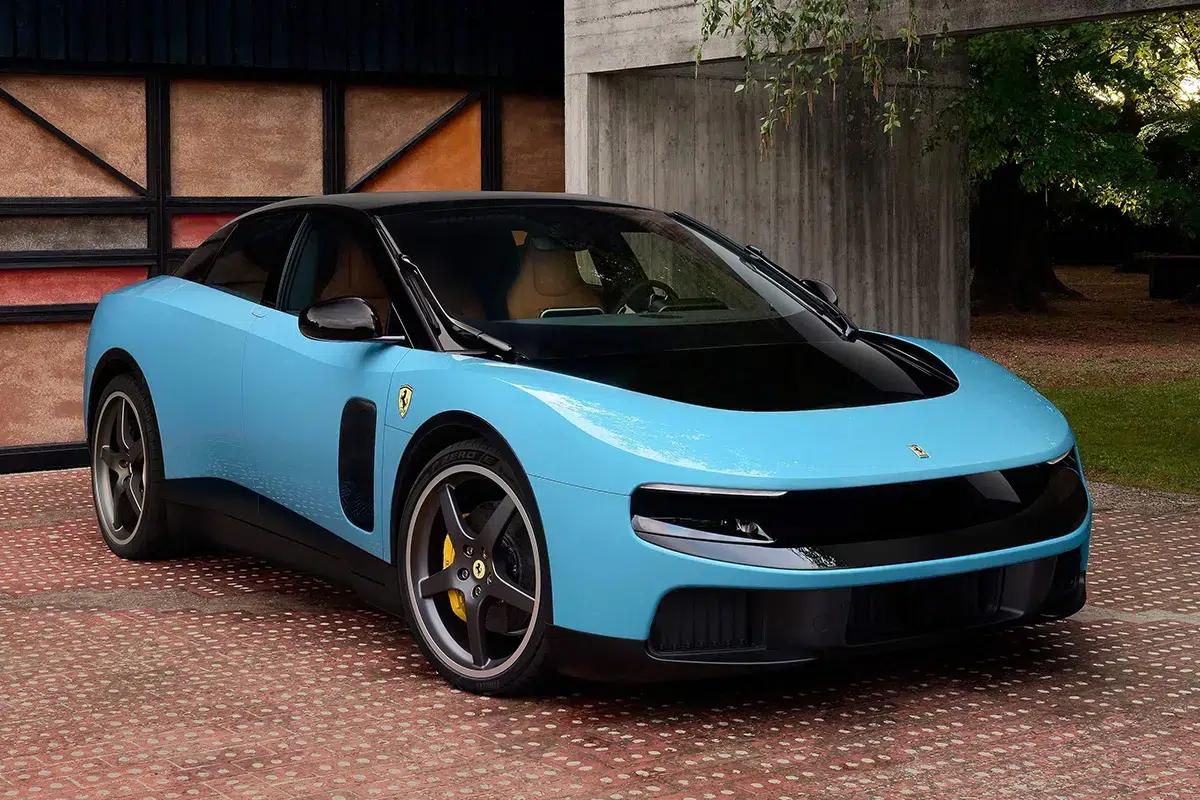

Not tap a screen. Not hold a brake pedal and navigate a settings menu. Pull a physical aluminium lever mounted above your head, aircraft-style, and hold on. Ferrari’s engineers went through more than 20 rounds of testing just to get the feel and sound of that pull exactly right.
In a car designed to court a generation raised on touchscreens, that detail says everything.
Everyone Missed the Lever
Every other performance EV buries launch control in a software menu. Ferrari machined a dedicated aluminium lever, mounted it on the ceiling like a helicopter collective, and made it glow orange. That single decision tells you more about what Ferrari actually believes than any press release written in the last six months.
The Porsche Taycan does it through a screen sequence. The Lucid Air uses a brake-hold procedure. Tesla’s approach has been a settings toggle. Each of those is a software solution to a physical problem, which is how Silicon Valley thinks about everything: find the physical object, replace it with a gesture.

Ferrari looked at that consensus and built a lever. A real one, with weight and resistance, that you pull with intent. Ferrari’s own press materials describe it as inspired by helicopter instruments.
The lever isn’t a quirk. It’s a position statement.
The Contradiction at the Heart of the Luce
Ferrari and LoveFrom built the Luce for a tech-forward audience. Then filled it with objects that reward people who care how things feel in the hand. The manettino, the E Ink key, the glass gear selector, the launch lever. None of these are a tech company’s decisions. They’re a watchmaker’s.
The interior contains more than 40 separate pieces of Corning Gorilla Glass. The three-spoke steering wheel is machined from 19 individual CNC parts in recycled aluminium. The air vent shields flip with what Ferrari describes as “satisfying tactility.” The dashboard’s aluminium substrate spans the full width of the car as a single piece.
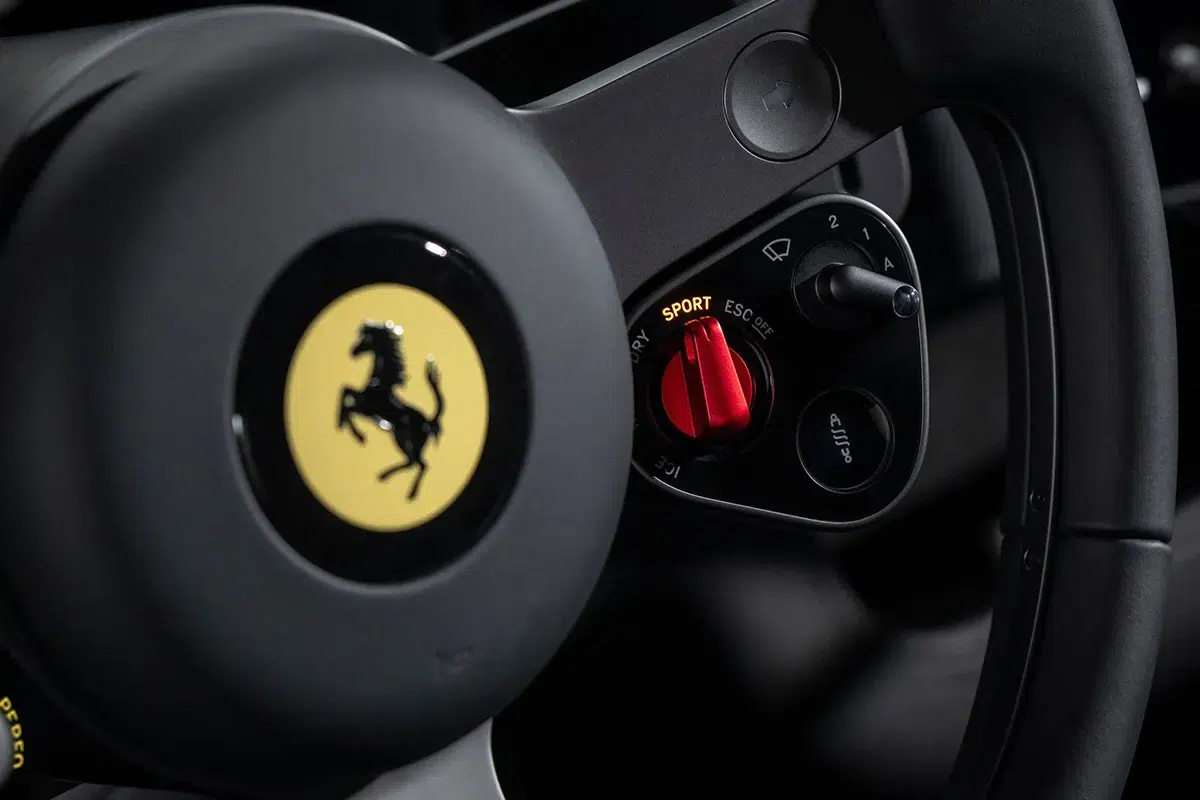
None of that is minimalism in the Apple sense. It is maximalism in the Patek Philippe sense. Every surface is accountable. Every interaction is a small ceremony.
Our first Luce article noted that Shmee150 observed the people approving of the Luce at the Rome reveal were wearing smartwatches, and the people who hated it were wearing mechanical watches. The interior details suggest Ferrari’s actual sympathies lie with the second group, whatever the marketing says about the first.
What Jony Ive Actually Built
Jony Ive spent his Apple career making technology disappear. Thin. Seamless. Frictionless. The Luce interior does the opposite: it makes every interaction a deliberate physical act. That is either a contradiction or an evolution. LoveFrom’s own team says it was entirely intentional.
Jeremy Bataillou, the LoveFrom industrial designer who led the interior, told Wallpaper that “touchscreens and capacitive switches are completely inappropriate for cars.”
That is a remarkable thing for a member of Jony Ive’s studio to say in 2026. Ive built his reputation on capacitive glass. The iPhone is the reason half the car industry ripped out their buttons in the first place. And here is his studio, five years into designing Ferrari’s first EV, arriving at the conclusion that physical switches are not a concession to nostalgia. They are the correct answer.
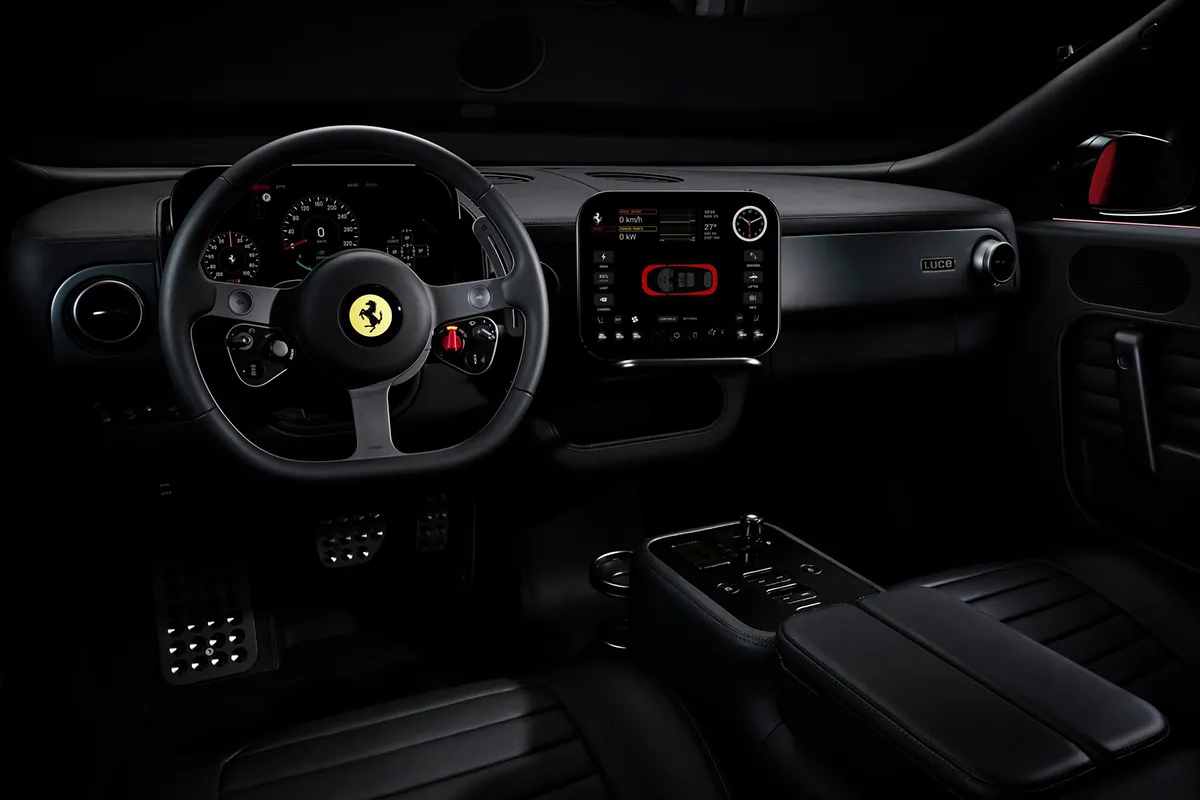
The cockpit reflects that conclusion fully. Real buttons. Real toggles. Two manettinos. A gear selector in Corning glass weighted to feel deliberate. And above the driver, glowing orange, the lever that starts it all.
The Tail-Lights Know What They Are
The four circular halo tail-lights are a direct reference to the 360 Modena and 458 Italia. On a car this radical, that is not nostalgia. It is Ferrari telling you exactly how seriously it takes the break from its own past.
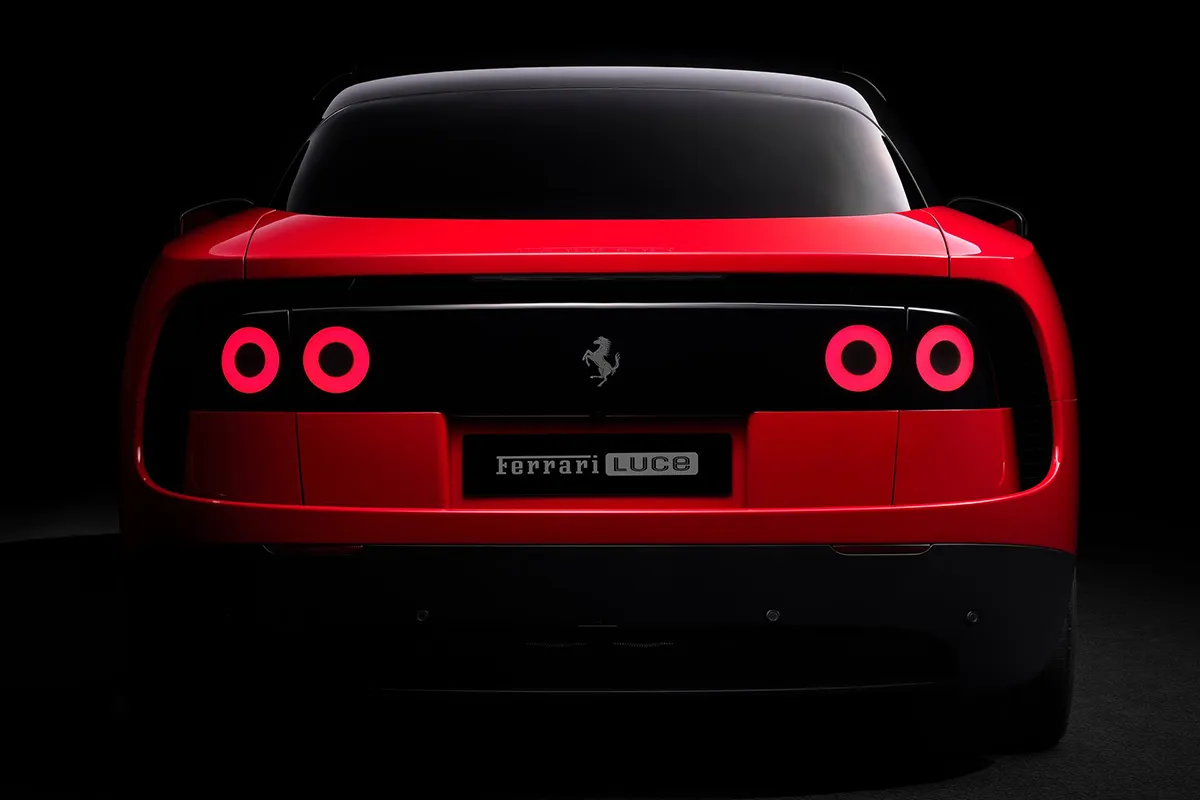
Everything else on the Luce exterior is a departure. The floating nose. The glasshouse shell. The rear-hinged coach doors. The 24-inch rear wheels, the largest ever fitted to a production Ferrari. The wipers parked at the sides. The absence of anything that looks like a traditional Ferrari rear end.
Except those four circles. Ferrari kept them deliberately, referencing two of the most loved cars in the modern catalogue. The message is not “we remember.” The message is “we know what we’re walking away from, and we’re walking anyway.”
Whether the lever, the manettino, and the forty pieces of Gorilla Glass are enough to convince the mechanical-watch crowd that this is still their Ferrari: that question won’t be answered in a press release. It will be answered the first time someone pulls that lever for real.


