

There is a version of this car that costs $30,000, makes more power than a Mk6 R, and will still be worth something in three years. There is also a version that costs $30,000, has been flashed four times by three different tuners, and is about to cost you a gearbox. They look identical in a listing.
This guide covers both halves of that problem: how to buy a good one, and what to do with it afterwards. The short version on tuning is that Stage 1 is where nearly all the value sits, and the rest of the money is usually better spent on tyres, brakes and maintenance. The long version is below.
One thing to settle first. This is about the GTI and R specifically, both of which use wet-clutch transmissions. If you are cross-shopping an ordinary 110TSI or 103TSI, that is a different car with the dry-clutch DQ200 and a different set of risks, covered in the Mk7 and Mk7.5 DSG buying guide.
Which one should you actually buy?
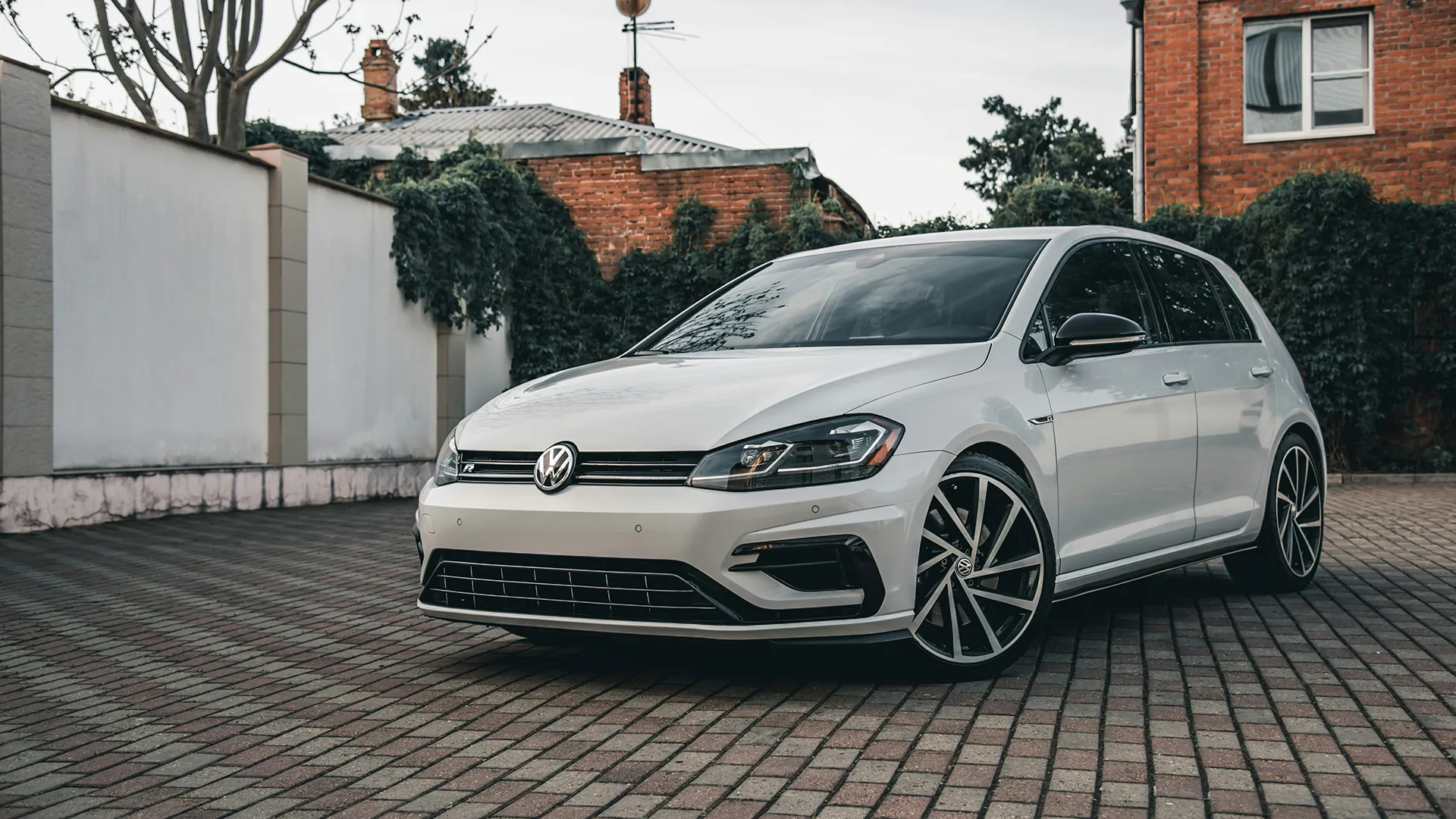
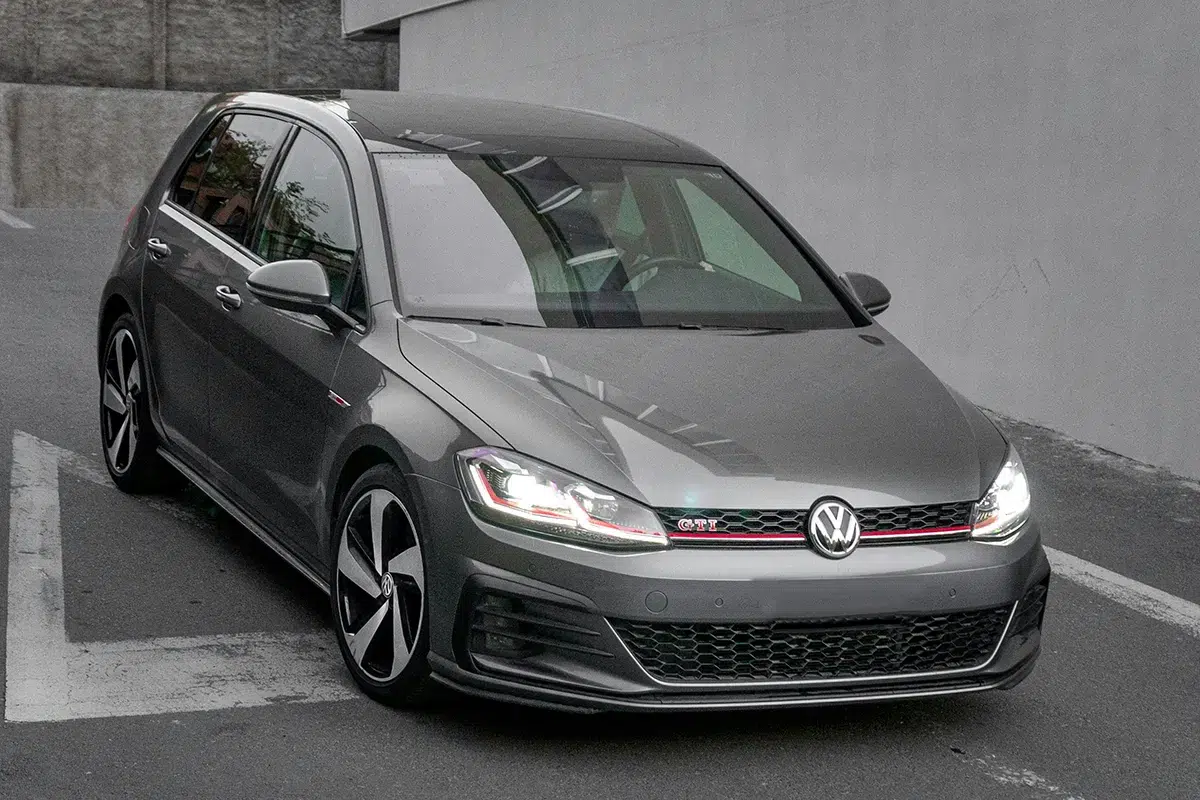
The GTI is front-wheel drive with an IS20 turbo and a wet-clutch DSG. The R adds 4MOTION all-wheel drive and the larger IS38 turbo, which is the single most important difference once tuning enters the conversation. Both use the EA888 2.0-litre, so the platform, the software and most of the maintenance story are shared.
Golf GTI vs Golf R
GTI or R?
The R is quicker and always will be, but the gap is smaller than the price difference suggests once both are tuned. Where the R genuinely separates itself is traction. A Stage 1 GTI on a damp roundabout is a front-wheel-drive car with 300-odd Newton metres more than it was designed around, and it lets you know.
The GTI is the better answer if you drive mostly in the dry, want the lighter nose, and would rather spend the difference on suspension and tyres. The R is the better answer if you want the power down in all conditions, or if you intend to go past Stage 1, because the IS38 has considerably more headroom than the IS20.
What actually changed between Mk7 and Mk7.5?
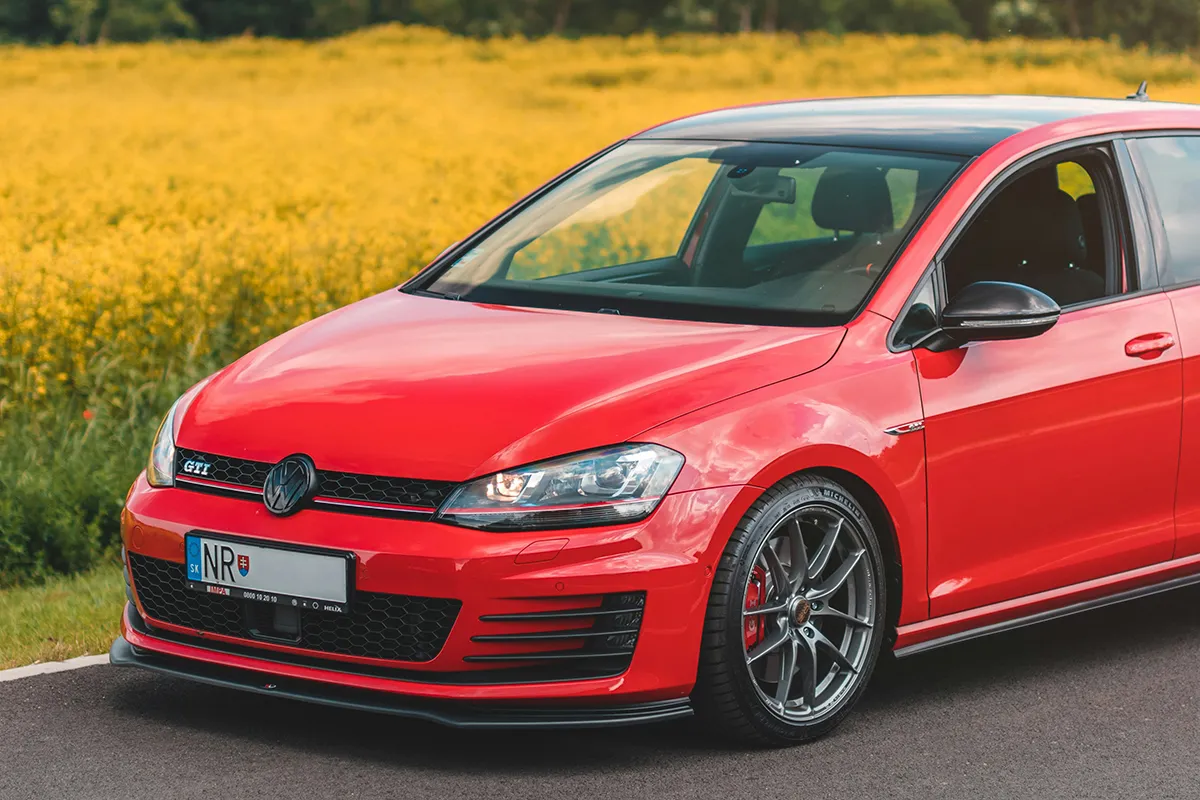
Both performance models gained a little power at the 2017 facelift. The GTI went from 162kW to 169kW, the R from 206kW to 213kW, and the Mk7.5 R picked up a seven-speed DSG where the Mk7 R used a six-speed. Volkswagen quoted 4.8 seconds to 100km/h for the Mk7.5 R with DSG, against 5.0 seconds for the Mk7.
The infotainment jumped a generation too, with the Mk7.5 R getting the 9.2-inch Discover Pro system, Active Info Display and gesture control as standard. If you are buying a Mk7 and the screen bothers you, that is a solvable problem with a modern head unit rather than a reason to stretch budget.
Is the Mk7.5 worth the extra money?
For most buyers, yes, and not for the reason people assume. The seven kilowatts are irrelevant, especially if you are going to tune it. The real argument is what happened to the engine around the same time, which is covered properly in the reliability section below and is the strongest single case for buying the later car.
Buying used: what to check before you hand over money
Assume every car you look at has been tuned until you can prove otherwise. On a platform this easy to flash, with software this cheap, the base rate is high. A previously tuned car is not automatically a bad buy, but a car whose owner denies a tune that the ECU remembers is telling you something about everything else they have said.
How can you tell if a Golf has already been tuned?
Start with the ECU itself. A VAG-specific tool reads the software version and, on many of these cars, a flash counter that increments each time the ECU is written. A mismatch between the software number and what the factory shipped is the clearest single indicator available to a buyer.
This is exactly the job that VCDS or OBDeleven exists for, and neither is expensive against the cost of getting it wrong. A generic code reader will not show you any of this. It will tell you the engine light is off, which is the least interesting fact about the car.
Physical evidence matters too. Look for an aftermarket intake, a non-standard intercooler, missing or replaced downpipe hardware, and boost or gauge pods. A car wearing Stage 2 hardware with a seller insisting it is stock has either been misrepresented to them or is being misrepresented to you.
What should you scan for beyond the tune?
Pull every stored and pending fault, not just the ones illuminating a light. Misfire counters, boost deviation faults, DSG clutch adaptation values and any coolant or thermostat codes are the ones that matter on this platform. Readiness monitors reset by a recent battery disconnect are worth a second visit.
The full pre-purchase process is worth doing properly rather than in a hurry on someone’s driveway, and a structured scan-based inspection will surface most of what a seller would prefer you missed. Budget an hour and do it cold.
Buying at Grays or Pickles: what you are actually accepting
Auction cars are cheaper for structural reasons, not because nobody else noticed. You typically get limited or no test drive, sale as-is with no statutory warranty, and a buyer’s premium on top of the hammer price. For a platform where a mechatronic unit or a turbo can cost four figures, that is a meaningful transfer of risk onto you.
If you are going that route, inspect during the viewing window with a scan tool in hand rather than relying on the listing photos. Ex-fleet and ex-lease cars can be genuinely good buys with real service history behind them. Repairable write-offs and cars with no history are a different proposition entirely, and the discount is rarely as large as the risk.
Set a walk-away number before the auction opens and hold it, including the buyer’s premium and any transport in that figure rather than adding them afterwards. The single most expensive habit in auction buying is deciding what a car is worth while bidding on it, surrounded by people doing exactly the same thing.
What actually goes wrong with these cars
The EA888 is a strong engine with a small number of well-documented weak points, most of which are cheap to check and moderately expensive to fix. None of them should stop you buying. All of them should inform what you pay.
Carbon buildup, and the best reason to buy a Mk7.5
Direct injection sprays fuel straight into the cylinder, which means nothing washes the back of the intake valves. On direct-injection-only engines, carbon accumulates there over tens of thousands of kilometres and eventually shows up as rough idle, misfires and a soft top end. The fix is walnut blasting, and it is a labour bill.
Around 2017, coinciding with the Mk7.5, Volkswagen introduced a revised EA888 with port injectors added alongside the direct injectors. The port injectors periodically wet the valves, which substantially reduces the deposits. That single change is a better argument for the later car than any power figure.
It does not make the Mk7 a bad buy, and plenty of pre-facelift cars run cleanly on good servicing and regular use. It does mean that on a higher-kilometre example you should factor an intake clean into your first year of ownership rather than meeting it as a surprise at the worst possible moment.
Water pump and thermostat
The plastic thermostat and water pump module is the most common non-gearbox failure across this engine family. It usually announces itself as a slow coolant loss, a low coolant warning or a sweet smell after a drive rather than a roadside failure. Parts are reasonable, labour is not, because access is poor.
Check the coolant level and look for crusty residue around the pump housing on any car you inspect. An owner who has already replaced it with the updated part has done you a favour worth several hundred dollars.
DSG and Haldex servicing
Both performance models use wet-clutch transmissions, which is good news. Wet clutches run in an oil bath that cools and lubricates them, and they take a scheduled oil and filter service that a dry-clutch box does not. Ask for evidence it has been done. On a tuned car, ask twice.
The R adds a second fluid nobody remembers. The Haldex coupling that drives the rear axle has its own oil and filter requirement, separate from the gearbox and separate from an engine service. It is routinely skipped by owners and by generalist workshops, and a neglected Haldex is a common reason a used R feels less all-wheel-drive than it should.
What high kilometres actually mean here
These engines regularly run past 200,000km when serviced. Kilometres matter far less than evidence, and a 140,000km car with a folder of receipts from a marque specialist is a safer buy than an 80,000km car with three stamps and a story. Oil changes on a tuned car should be more frequent than the factory interval, not less.
Tuning: what the stages actually mean
Stage numbering is a convention, not a standard. Every tuner defines the boundaries slightly differently, and a Stage 2 file from one company may assume hardware another calls Stage 1.5. What follows is the common understanding across the platform, but confirm the specific hardware requirement with whoever writes your file.
Understanding Tune Stages
Stage 1
Stage 1 recalibrates the standard hardware. No parts, no fabrication, no compromise to how the car behaves cold or in traffic. On a turbocharged engine that left the factory deliberately conservative for warranty, emissions and global fuel quality, there is real headroom to recover.
Stage 1.5
The vaguest of the three, and the one most likely to mean different things at different workshops. Generally it assumes an intake and sometimes an intercooler, and the honest gain is less about peak power than about the car holding its numbers on a hot day or a second consecutive run.
Stage 2
Stage 2 assumes exhaust hardware. A downpipe and a free-flowing back half let the turbo spool and breathe, and the tune raises boost to suit. Run Stage 2 software on a stock exhaust and you leave power unclaimed. Fit a downpipe without the matching file and you have spent money for noise.
Beyond Stage 2
This is where the platform stops being a tuned road car and becomes a project. Etuners Motorsport publishes a Golf 7R result of 236.5 all-wheel kilowatts from a Stage 2 ECU and DSG calibration, a gain the company records as 51 all-wheel kilowatts. Going meaningfully past that means turbo, fuelling and driveline work.
Why Stage 1 is where your money is best spent
Stage 1 delivers the largest single improvement per dollar available to these cars, and it does it without touching a bolt. Every stage after it costs more, returns less, and moves the car further from the reliability envelope Volkswagen engineered. If you only ever do one thing, do this one.
What does Stage 1 actually gain?
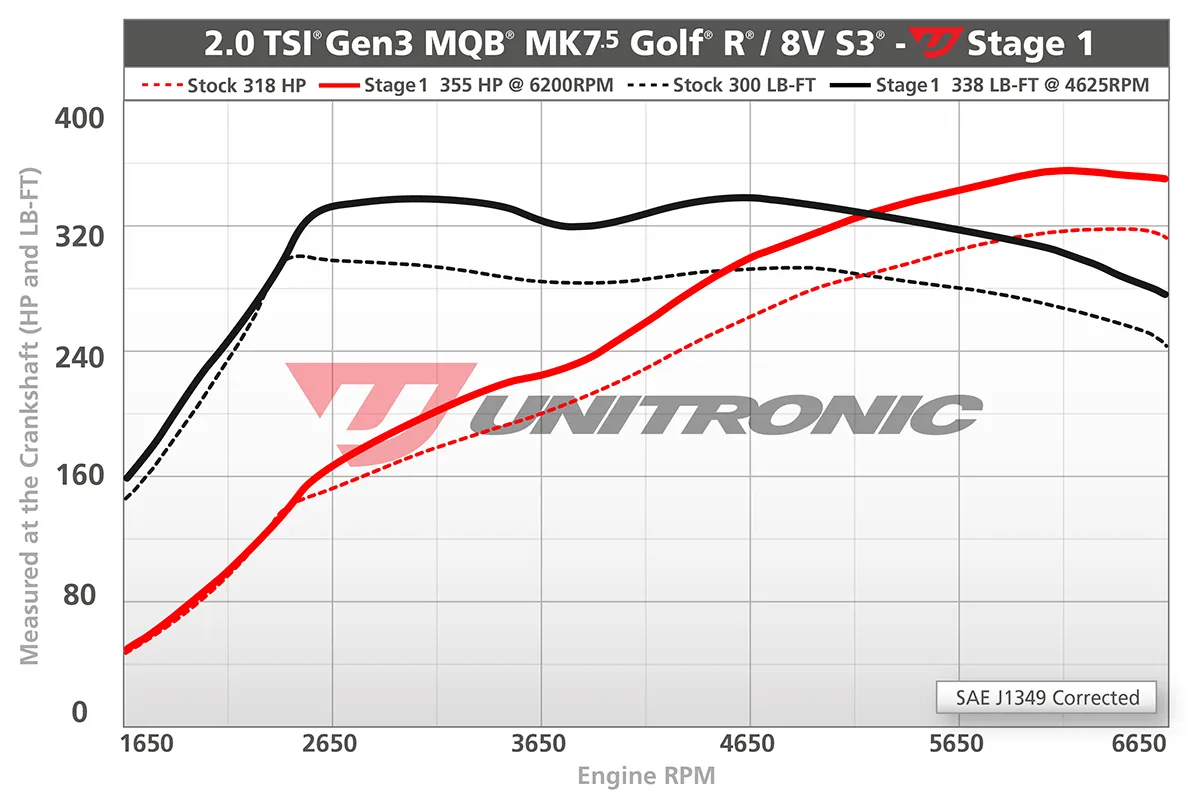
Published gains vary by tuner, fuel and car, so treat any single number with suspicion. As a general expectation across the platform, a Stage 1 GTI or R picks up a substantial slice of power and a larger slice of torque, with the torque arriving earlier and staying longer. The peak figure is not the point.
What owners consistently describe is the mid-range. These engines leave the factory with a soft area in the mid-range where boost is deliberately restrained, and a good Stage 1 file fills it. That is the part of the rev range you actually use on a road like the Black Spur, which is why a tuned car feels transformed at legal speeds rather than only at the top end.
Fuel matters more than most people expect. Australian 98 RON files make meaningfully more than 95 RON files, and running the lower grade on a file calibrated for the higher one is asking the knock sensors to protect you. Buy the fuel the file was written for, every time.
Is Stage 1 safe for a GTI or R?
On a healthy, well-maintained car with a properly calibrated file, Stage 1 is the mildest thing you can do to these engines and the least likely to shorten anything. It stays within the factory turbo, factory fuelling and factory cooling. The failures people attribute to tuning are usually failures attributable to a neglected car that happened to also be tuned.
The genuine caveats are worth stating plainly. A car with a tired water pump, old plugs, a marginal high-pressure fuel pump or unserviced gearbox oil will find those weaknesses faster with more torque going through it. Fix the maintenance first, then tune. In that order, not the reverse.
The other real risk is a bad file rather than the concept of tuning. A cheap generic map bought online and flashed at home, with no data logging and no knowledge of your specific car, is a different product to a calibration developed on a dyno with logs. Both get called Stage 1.
Should you tune the DSG at the same time?
If the car is a DSG, yes, and this is the upgrade people skip and then regret. The factory transmission calibration includes torque limits that will simply cut your new engine output back, plus shift logic written around the stock power curve. A TCU tune raises the limits and sharpens the shifts.
It also lets the tuner set clutch clamping pressure appropriate to the torque you are now making, which is a reliability measure rather than a performance one. Doing ECU and TCU together in the same session is both cheaper and better than doing them months apart.
Where to get it done in Australia
The choice that matters is not which brand of software, it is whether the file is calibrated to your specific car or downloaded to suit your model. Custom dyno tuning with data logging costs more and is worth it, particularly on a car with any hardware changes or any accumulated wear.
Underground Performance
Underground Performance, known in the scene as UGP, operates out of Braeside in Melbourne’s south-east and does custom dyno ECU and gearbox tuning for European cars, alongside performance parts supply, installation and specialist servicing. They also offer Galano Engineering MQB tuning solutions and run a dealer network.
Etuners Motorsport
Etuners Motorsport develops custom ECU and TCU software for VAG and European cars, with each car going through a tuning session of flashing and data logging rather than receiving an off-the-shelf file. The company covers everything from Stage 1 to big turbo builds and supplies and installs performance parts in house.
Off-the-shelf versus custom
The established software brands, APR and Unitronic and 034 Motorsport among them, sell proven files through installer networks and they work. They are calibrated to a model rather than to your car, which is fine on a stock, healthy example and less fine on a modified one.
Custom tuning earns its premium when the car has hardware changes, when it has high kilometres, or when you want the file adjusted around what the logs actually show rather than what the average car does. Ask any tuner to show you the before and after logs, not just the dyno graph.
The mods worth doing, and the ones that are not
Rank your spending by what limits the car. On a Stage 1 GTI or R, the limits are almost never engine output. They are tyres, then brakes, then dampers, then the driver. Money spent in that order transforms the car. Money spent chasing peak kilowatts mostly transforms your service bill.
Tyres, brakes and suspension first
A Stage 1 car on tired all-season tyres is slower everywhere that matters than a stock car on good rubber. This is the least glamorous and most effective money in the entire modification list, and it improves braking and wet safety at the same time.
Brakes come next, and on the GTI in particular the standard setup gets warm quickly with sustained use. Pads and fluid are the cheap and correct first step. Big brake kits are further down the list than the internet suggests.
Suspension is where these cars respond well and where it is easy to overspend. Quality coilovers or a good spring and damper package sharpen the car without wrecking it. Cheap coilovers make it worse in every measurable way while looking better parked.
If the wheels are changing at the same time, and they usually are once the factory 18s are worn out, check the package before you order rather than after it arrives. Our wheel and tyre fitment calculator works out the diameter change, what it does to your speedo, how far the new offset pokes, and whether the load index still meets your placard. That last one is where plus sizing quietly goes wrong: the size you want may only exist in a load rating below what the car is placarded for, and it is one of the few things on this list with no certification path at all.
Intake, intercooler and downpipe
An intercooler is the most genuinely useful of the three in Australian conditions, because heat soak is the real enemy on a hot day and a bigger core keeps intake temperatures sane on repeated runs. An intake mostly changes the noise on a Stage 1 car, which is a legitimate thing to want as long as you know that is what you are buying.
Downpipes are Stage 2 territory and carry a compliance dimension. Emissions equipment is regulated for road-registered vehicles, and a catless downpipe on a street car is a defect and roadworthy problem in most states. Understand the rules where you live before you spend.
The money pits
Big turbo builds on a daily-driven car, cheap coilovers, and any part bought purely because a build thread had one. Also worth naming: chasing a dyno number rather than a driving experience, which is how people end up with a peaky car that is slower on a real road than the Stage 1 version was.
If you want to spend money on the car and the mechanicals are sorted, paint protection is a better use of a weekend than another power part. A decent DIY ceramic coating costs less than an intake and does more for the car’s value.

What tuning does to warranty, insurance and resale
All three matter more than the forums suggest, and all three are manageable if you are honest up front. The expensive version of this conversation is the one you have after something has already broken, when the paperwork you did not do becomes the reason a claim gets declined or a buyer walks.
Does a tune void your warranty in Australia?
Not automatically, and the blanket claim that it does is wrong. Under Australian Consumer Law a manufacturer cannot void an entire warranty simply because aftermarket parts or software have been fitted. What they can do is decline a specific claim where the modification caused the failure.
In practice that distinction is where the argument happens. A tuned car with a failed turbo will face a much harder conversation than a tuned car with a broken window switch. Most Mk7s are now well outside the original factory warranty period anyway, which makes this largely a question for late Mk7.5 buyers and anyone with extended cover. This is general information rather than legal advice.
Do you have to tell your insurer?
Yes. Modifications are a material fact, and failing to disclose a tune gives an insurer grounds to reduce or refuse a claim. That includes software, which people routinely assume does not count because there is nothing physical to point at under the bonnet. An assessor with a scan tool will find it.
Some insurers are relaxed about a Stage 1 flash and some load the premium significantly. Ring before you tune rather than after, and get the answer in writing. A declined total loss claim costs more than every modification on the car combined.
What it does to resale
A tuned car sells to a smaller pool of buyers, and a proportion of that pool will use the tune to negotiate. Keeping the original ECU file and being able to return the car to stock protects your position, as does a documented history from a named tuner rather than a vague claim that it has a map on it.
The used market’s suspicion is not irrational. It is the same suspicion this guide recommends you apply when buying. Owning the paperwork is what separates your car from the ones people are right to worry about.
Get amongst the community
The single most useful free resource for this platform in Australia is other owners. The GTI & R Owners Club Australia group on Facebook is where local builds, tuner recommendations, fault diagnoses and for-sale cars all surface, with the specific advantage that everything discussed is in Australian conditions, on Australian fuel, at Australian prices.
It is also the fastest way to sanity-check a quote or a car. Post the details of the example you are looking at and somebody will very likely have owned it, tuned it, or walked away from it already. That is information no listing will give you.
Read for a while before you buy anything. Watching what other people have built, what it cost them and what broke afterwards is considerably cheaper research than running the experiment yourself, and the search function will answer most first-time questions before you need to ask one.
The short answer
Buy the healthiest, best-documented car you can find rather than the cheapest or the most powerful. Scan it before you pay. Fix the maintenance backlog before you add power. Then do Stage 1 with ECU and TCU together, on 98, from someone who logs your car rather than emailing you a file.
After that, spend the next lot of money on tyres and brakes and stop reading build threads for a while. The Mk7 GTI and R are quick enough at Stage 1 to embarrass cars that cost three times as much, and the owners enjoying them most are almost never the ones with the biggest numbers.
The ones with the biggest numbers are usually in the group asking why it is in limp mode.


