
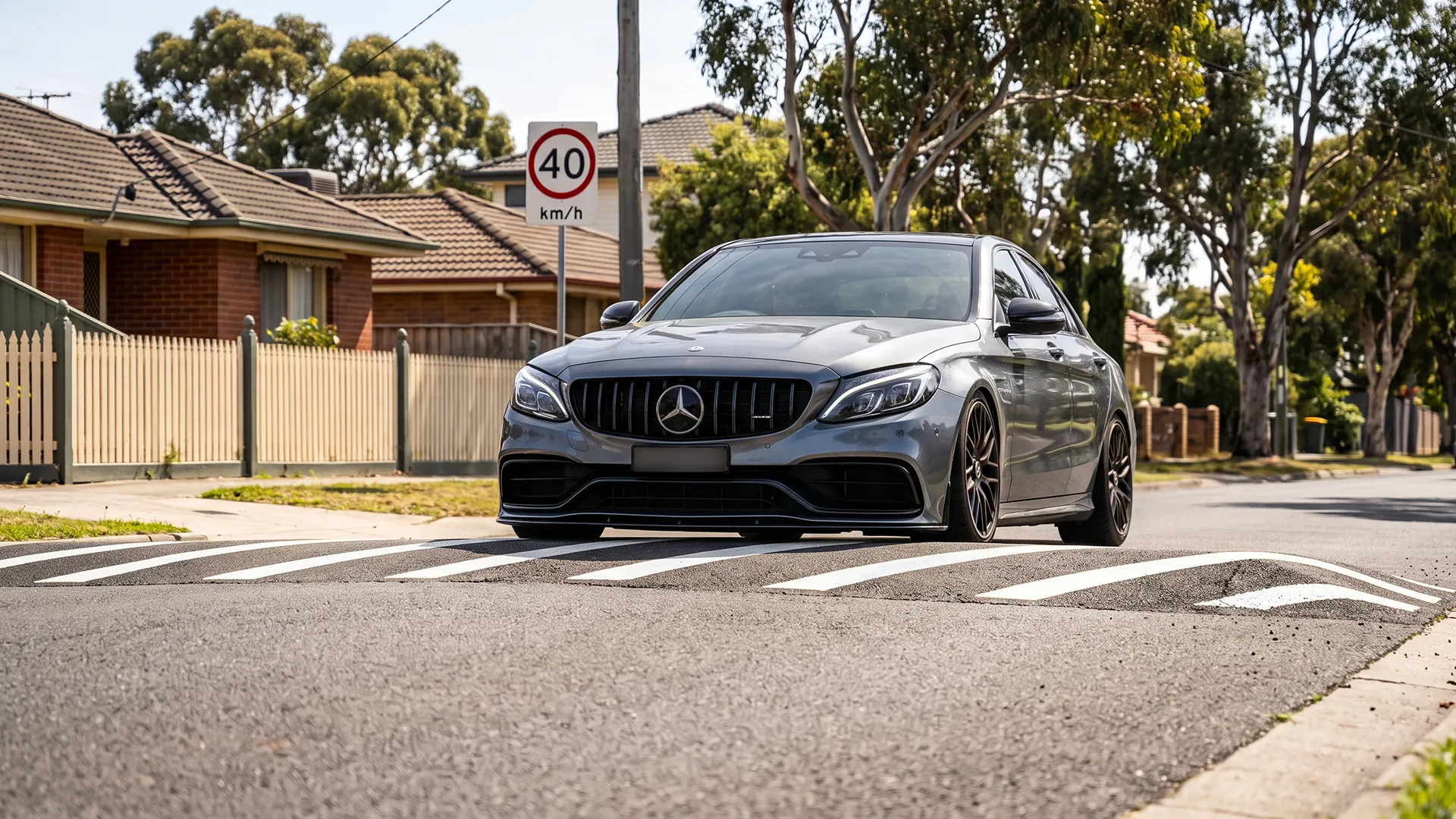

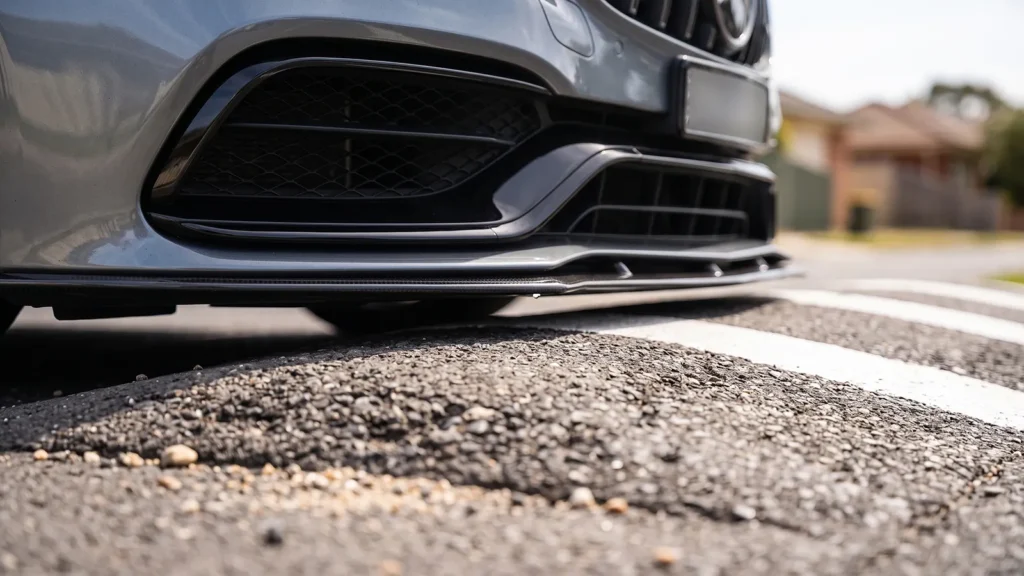
Your front lip scrapes at the shopping centre. It scraped there last month, and the month before, and by now you are quietly convinced someone has been building the things taller.
They have not. What has changed is where you meet a hump and what shape it is when you get there. The number quietly destroying splitters sits in a standard most drivers have never heard of, and it is entirely legal.
The Public Road Hump Has Not Grown
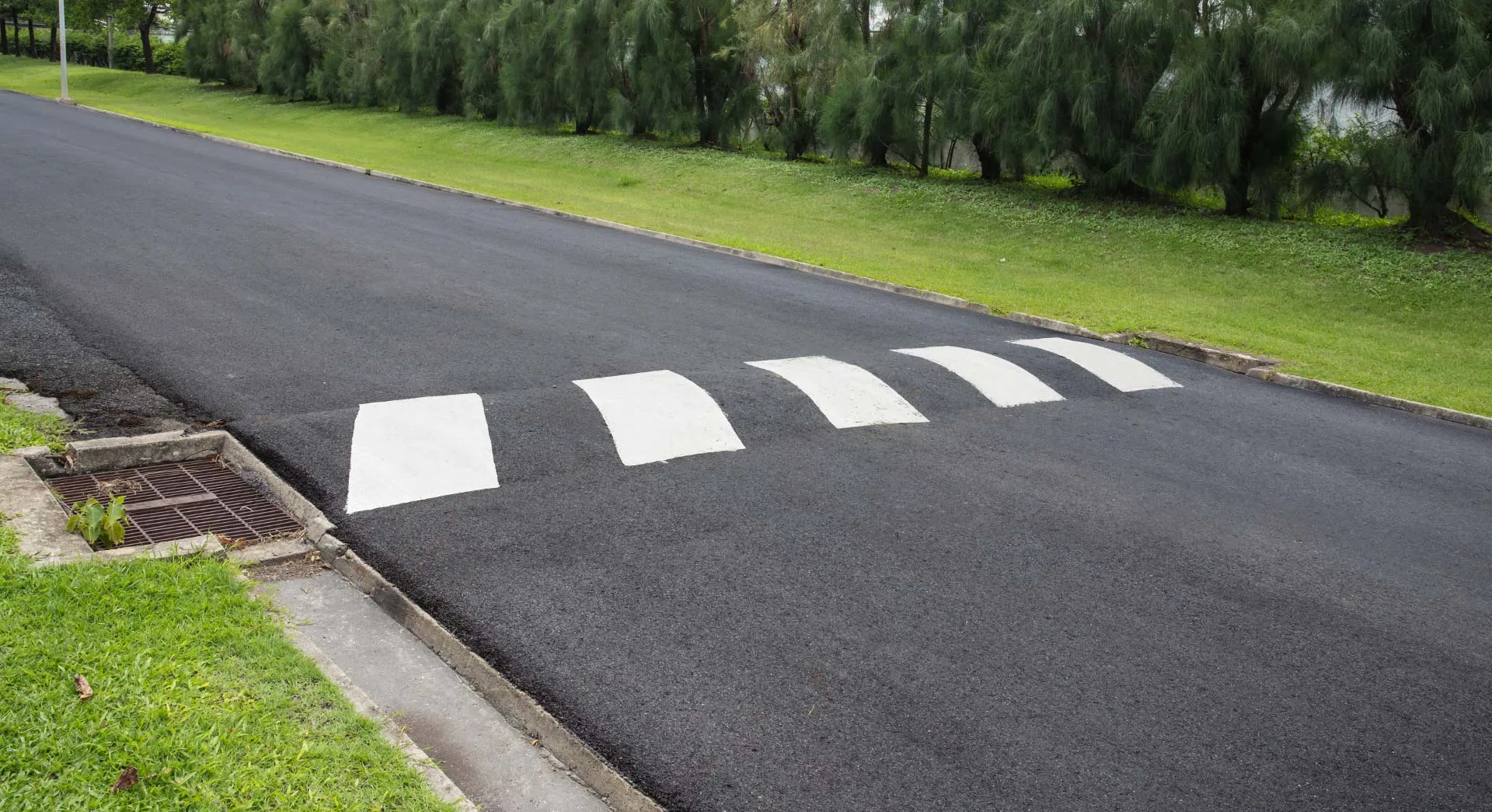
Councils build to a shared template rather than an ever-rising number. The Watts profile road hump is a circular arc 3.7 metres long, tapered near the kerb for drainage and signed for 20km/h. Adelaide’s City of Charles Sturt publishes that exact drawing, and it has not changed shape in years.
The drawing cites AS 1742.13, the Australian Standard for local area traffic management, and Austroads Guide to Traffic Management Part 8, Figure 8.3. Same arc in Melbourne. Same in Perth. That consistency is the whole point of a standard.
The One Wrecking Your Splitter Is on Private Land
Car parks run under a completely different rulebook. AS/NZS 2890.1:2004 covers off-street parking, and its Type 2 hump is 25 to 75mm high with a 1:2 ramp: two units along for every one up. Shorter than a road hump. Vastly steeper.
Type 1 is the civilised version, up to 75mm spread over 2,500mm, meant for long aisles in open-air car parks at 30-metre spacing. Type 2 is the bolt-down rubber unit in basements and multi-storey decks, spaced from 10 metres, wearing 250mm alternating stripes. A kerb with better PR.
Speed Hump Specifications
Why 1:2 Is the Number That Actually Hurts
Your car is engineered against a far gentler figure. The National Code of Practice for light vehicle modification, Section LS clause 2.1.4, requires 100mm of clearance within a metre of an axle and demands the car clear a crest with 1:15 grades on both sides.
So the design case is 1:15. The compliant car park hump is 1:2. That is roughly seven times steeper than the worst crest your suspension geometry was ever signed off against, and no amount of council-bashing shifts it.
So Is Anyone Actually Breaking the Rules?
Rarely, and a standard is not law on its own. It binds once a state road authority calls it up. Queensland’s Manual of Uniform Traffic Control Devices Part 13, published November 2023, applies AS 1742.13-2023 and states it takes precedence in Queensland.
That manual is specific where it counts. On bus routes it caps hump height at 100mm, holds ramp grade to a maximum of 1:15, and requires a flat top of at least 6.0 metres for single-unit buses and 8.0 metres for articulated ones.
What you are far more likely to hit is a badly built one. An asphalt hump laid over an older hump. A resurfaced approach that lifted the run-in by 30mm. Those are construction defects, and the path is the council’s public liability process, not a crusade.
What This Means If You Drive Something Low
Owners of a GR86, a base Cayman or anything on aftermarket springs need to be honest about where the fault sits. If you are running coilovers wound down to the collars for the look, the car park is not the villain here.
The code also limits how far you may go: ride height must not change by more than one third of the suspension’s working travel. Drop past that and you are in the same defect notice territory that already polices exhausts.
The practical fix is duller than a conspiracy. Cross car park humps at a slight angle so one corner lifts at a time, learn which centres run Type 2 rubber, and buy a jack that actually fits under the car you own.
What Changes From Here
AS 1742.13 was revised in 2023 and is still working through state manuals, so expect more consistency on public roads rather than more height. Thirty-kilometre-hour precincts are adding raised platforms and flat-top plateaus, which are longer and gentler than a Watts hump.
The car park standard is the one worth watching, and it is not moving. AS/NZS 2890.1 has not been revised since 2004 and remains current in the Standards Australia catalogue. Twenty-two model years of Australian cars have got lower underneath it.
The verdict is not the one the internet wants. Speed bumps are not getting higher. Cars got lower, car parks are governed by a document written before anyone thought to bolt a splitter to a Corolla, and the scrape you hear is the gap between the two.


