

A regas is not a service. Your car’s air conditioning is a sealed system, and a sealed system doesn’t use gas the way an engine uses oil. If it needs a top-up, something is leaking. That makes the cheap regas special a very good deal for the workshop, because you’ll be back for the same job next summer.
The second sting arrives when the quote lands. Plenty of cars built over the past decade run a newer refrigerant, R1234yf, and it costs far more per charge than the R134a most drivers remember paying for. Here’s what a regas really costs in 2026, why the newer gas hurts, and where the real money goes when warm air starts coming out of the vents.

How much does a car aircon regas cost in Australia?
Expect roughly $170 to $199 to regas an older car running R134a, and $249 to $329 or more for a car running R1234yf, according to 2026 price guides from Going Rate and Brisbane workshop Ultimate Car Expert. That’s close to double for the same job. Broader Sydney quotes compiled by Servistar in September 2026 span $125 to $300, depending on what’s actually included.
Air Conditioning Repair Estimates
Treat every figure as a starting point. Workshop prices shift with location, vehicle and how much gas the system holds, and advertised “from” prices assume the easy case. The Going Rate regas cost guide and Ultimate Car Expert’s published price list are the sources for the regas bands above.
Why the newer gas costs so much more
It comes down to the raw material. Ultimate Car Expert quotes R1234yf wholesaling at $350 to $600 per kilogram, against $40 to $80 for R134a. Labour barely changes between the two jobs. The gas itself is the difference, and passenger-car charge weights run to hundreds of grams, so the markup lands on your invoice in full.
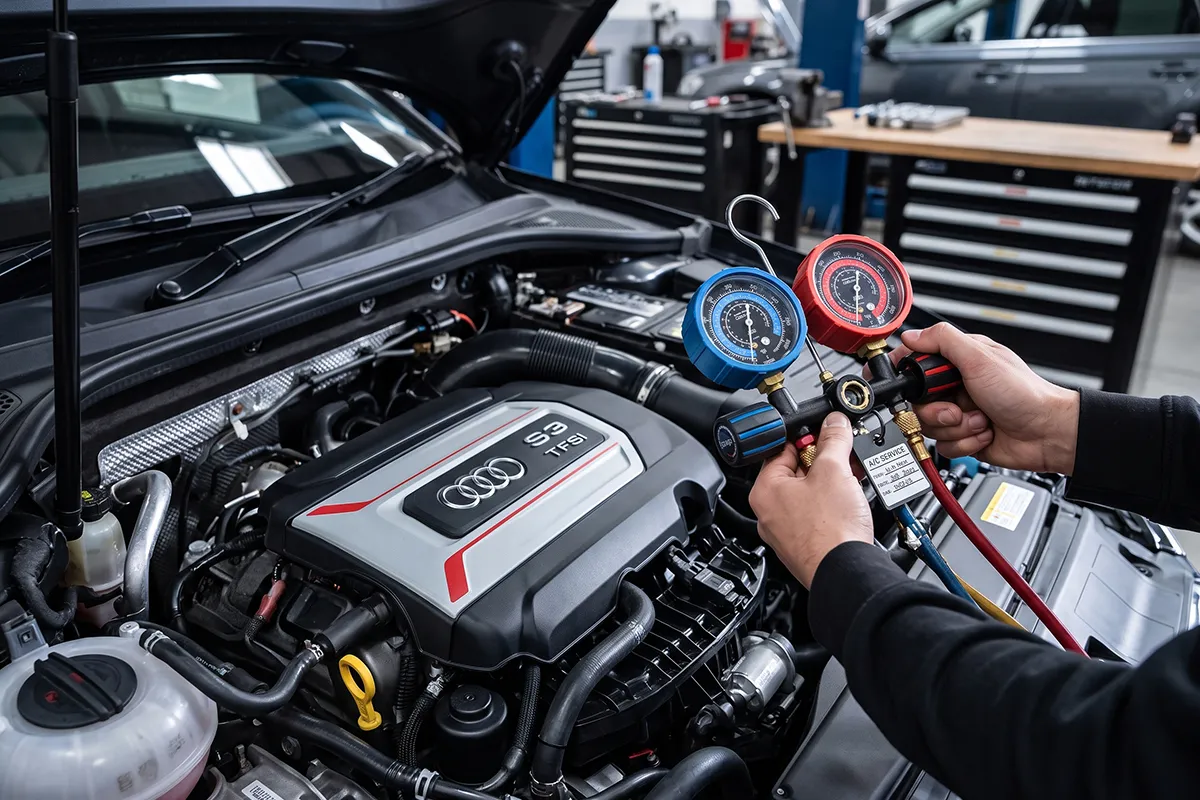
There’s more to it than price per kilo. R1234yf is rated A2L (mildly flammable) under the ASHRAE system, notes industry body VASA, so it needs its own dedicated recovery and charging machine. The service ports differ too, which stops anyone cross-filling one gas into the other. A workshop that only owns an R134a machine simply can’t do your newer car.
Which gas does your car take?
Check the label, not the build year. Most cars carry a sticker under the bonnet, often on the radiator support or bonnet underside, naming the refrigerant and charge weight. Australia never mandated a changeover date. European-market cars moved first, because EU rules required low-impact refrigerant in all new cars from 2017, while other brands kept shipping R134a here for years.
VASA’s survey of 2022 imports found R1234yf uptake only really accelerated that year. So “anything after 2017 runs the new gas” is a rule of thumb that will catch you out in both directions. A European hatch from the mid-2010s may already run R1234yf, while a later Asian-built model may still be on R134a. Read the sticker before you ring for quotes.
If it needs gas, it has a leak
A healthy system loses only a small amount of refrigerant each year. Going Rate puts the figure at about 10 per cent annually, which means a sound system can go several years between charges. If yours needs topping up every summer, the gas is escaping somewhere. Refilling without finding the leak is paying to cool the atmosphere, not your cabin.
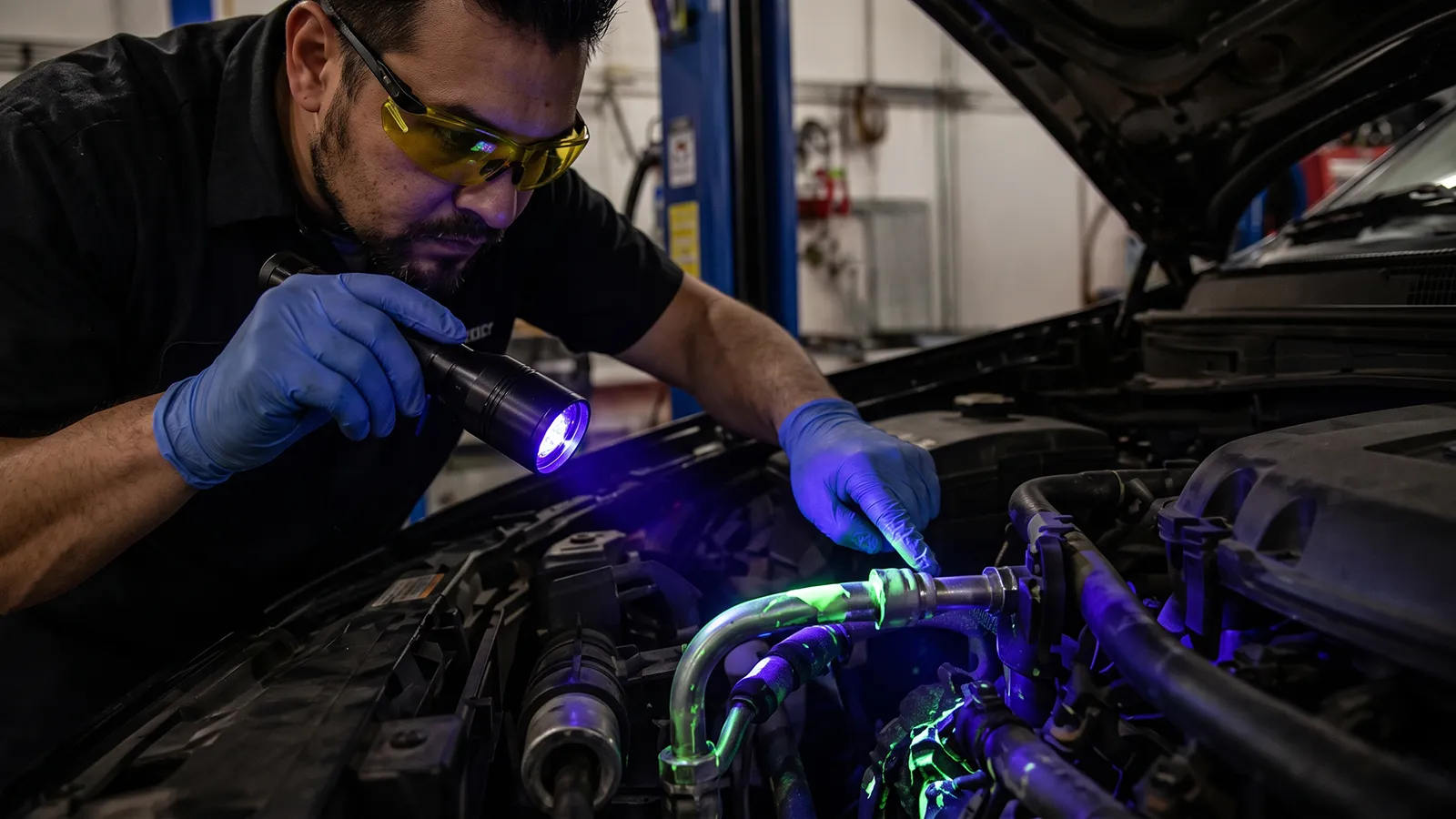
The fix is a leak test first. A UV dye goes into the system with the charge, and the technician uses a UV lamp to trace where it seeps out. Going Rate lists a leak test at around $60, and Ultimate Car Expert charges $89 but credits it against the regas. That’s the cheapest insurance you’ll buy on this job.
What a proper regas includes
A regas done properly is more than squirting gas in through a port. Ultimate Car Expert lists the steps it includes as standard, and they make a decent benchmark when you’re comparing quotes from any workshop, franchise or independent. If a step is missing from your quote, it’s probably missing from the job:
- Recovery of the old refrigerant
- A vacuum pump-down, which also shows whether the system holds a vacuum (a basic leak check)
- Charging the exact gas weight on the under-bonnet label
- A performance test, including vent temperature
If a quote doesn’t mention a vacuum test or leak check, ask. Two workshops both advertising an “aircon regas” can be describing very different jobs, as Servistar’s Sydney pricing breakdown points out. The cheaper one is often the one skipping the steps above.
When the leak is the expensive part
The regas is the small number. The part that’s leaking is the big one. AutoGuru puts a condenser replacement at around $500 to over $1,000, and a compressor replacement at $800 to $1,200 or more. Both need a fresh regas afterwards, so on an R1234yf car add the higher gas charge on top.
The condenser is the usual suspect on Australian roads. It sits right behind the front grille, taking stone strikes on every gravel stretch and every highway run behind a truck. Perished O-rings and worn service valves are the cheap outcomes. A seized compressor is the expensive one, and it’s often the end result of running a system low on gas and oil for too long.
EV owners have extra skin in the game. In many electric cars the same refrigerant circuit that cools the cabin also manages battery temperature, so a leak isn’t only a comfort problem. Heat-pump systems are complex and dealer-quoted, and they deserve a proper diagnosis rather than a guess.
The cheap fix nobody bothers with
Weak airflow isn’t always a gas problem. A clogged cabin filter chokes the fan, so the air coming out may be cold but there’s not enough of it, and it can smell musty. Going Rate lists cabin filter replacement at $30 to $80. It’s the first thing to check if the air is cool but barely moving.
Know the difference before you book. Warm air at full fan speed points to gas or a mechanical fault. Cold air at a trickle points to the filter. A car that smells like a wet dog every time the fan starts is almost always overdue for a filter, and it belongs on any first-time owner’s maintenance checklist.
Can you regas it yourself?
Short answer: don’t. Under Australian law, working on a vehicle’s air conditioning requires a refrigerant handling licence, and the Australian Refrigeration Council states that anyone acquiring or storing refrigerant must hold a Refrigerant Trading Authorisation. Beyond the legal problem, an over-charged system runs high pressures, and R1234yf is mildly flammable. This is one job to leave with a licensed tech.
Resale value and the tax angle
Air conditioning that blows warm is a gift to the buyer across the table. On a used-car inspection, run the system on max with the engine idling and feel the vent temperature. If it’s weak, price a compressor into your offer, not a regas. That habit sits alongside the checks in our guide to exposing a used car with an OBD2 scanner.
If the car is used for work, repairs can form part of your deduction under the ATO’s logbook method, claimed at your business-use percentage. The cents-per-kilometre method is different: its flat rate already covers running costs, so you can’t claim the regas separately. Novated leases usually bundle maintenance, so check your provider covers aircon. Speak to your accountant, as this isn’t tax advice.
Aircon is one line on a much longer bill. Tyres, insurance, registration and depreciation all stack up alongside it, and a neglected system is exactly the kind of small cost that snowballs. For the wider picture on running costs, see the true cost of owning a car in Australia.
R134a is on notice
The government wants to stop new cars arriving pre-charged with R134a. The Department of Climate Change, Energy, the Environment and Water has opened public consultation on a proposal that would require new vehicles to use a refrigerant with a global warming potential below 150 from 1 January 2028. Submissions close on 23 October 2026. Nothing is final, but the direction is clear.
Plenty of popular badges are still on the old gas. Data cited by Drive from Refrigerants Australia shows Kia, Hyundai, Isuzu and MG were shipping R134a as of 2024, while Mazda (except the BT-50) and Mitsubishi had already moved to R1234yf. Toyota is mid-transition, with the LandCruiser 70 Series and GR Yaris the holdouts, and BYD has switched everything except the first-generation Atto 3. “It has taken ridiculously longer than expected,” Refrigerants Australia executive director Dr Greg Picker told Drive.
That doesn’t touch the car already in your driveway. R134a stays available for servicing, but Australia’s HFC phase-down, which began in 2018 and cuts bulk imports by 85 per cent by the end of 2035, means supply only tightens from here. Owners of older cars, including many budget first cars under $10,000, shouldn’t count on R134a staying cheap forever.


