
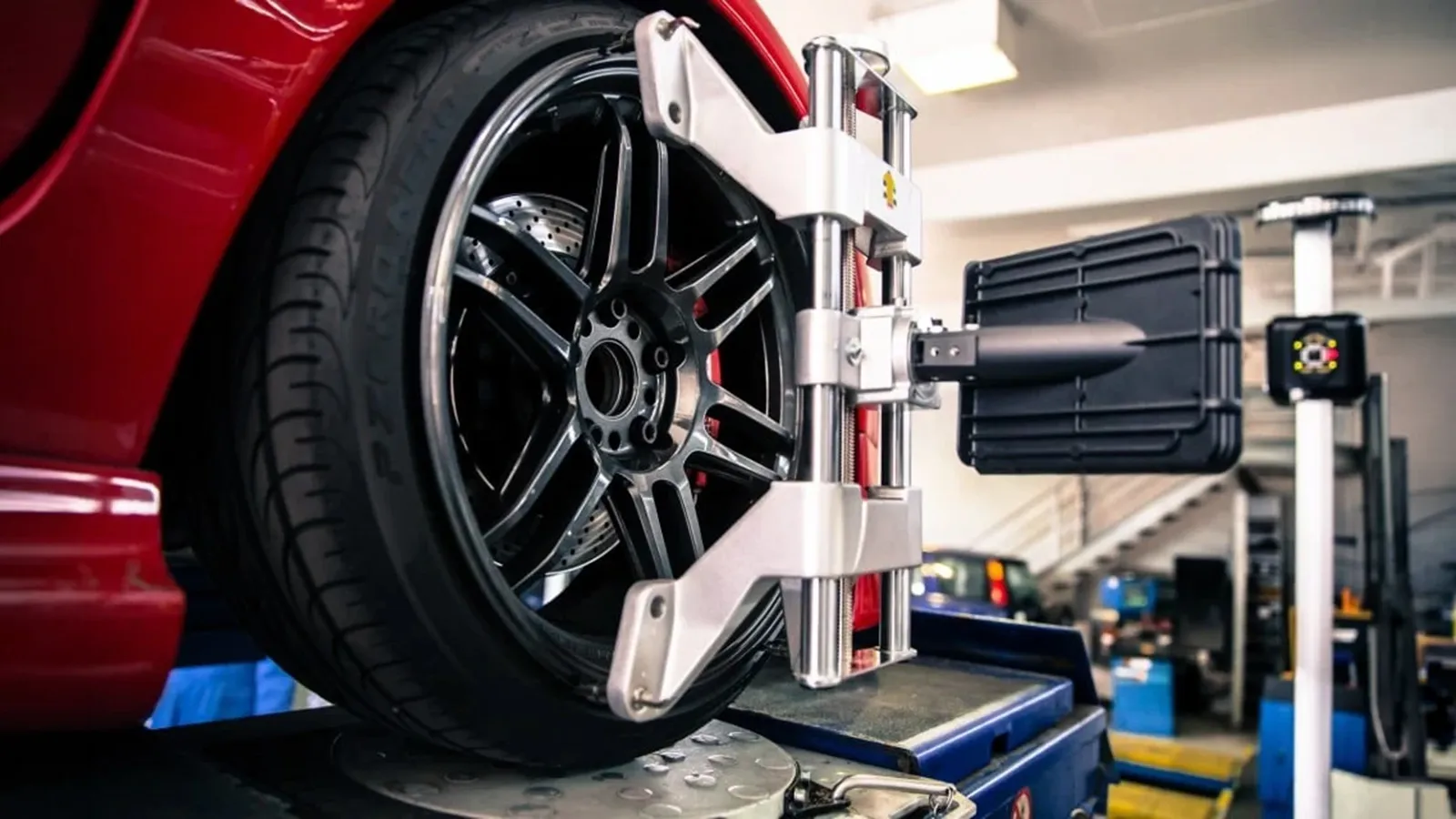

A wheel alignment in Australia is advertised anywhere from $79 to $140, and the shops quoting the two ends of that range will tell you they are selling the same thing. For a standard car on factory suspension, they mostly are. For a car sitting on coilovers, they are not, and the difference is not the price. It is whether the shop can physically do the job at all.
Here is what the published prices actually are, which of the three angles is quietly destroying your tyres, and why the cheap alignment special cannot correct a lowered car no matter how good the technician is.
What a Wheel Alignment Costs in Australia Right Now
Only some of the major chains publish a price at all. Of those that do, mycar lists alignment from $99 and says that figure covers both a two wheel and a four wheel alignment, while Bob Jane T-Marts lists from $79 without specifying what the entry price includes.
Wheel Alignment Pricing
How much is a wheel alignment in Australia?
Published prices start at $79 and most cars land between $80 and $120, with 4WDs, SUVs and anything on oversized tyres sitting at the top of that range or above it. Two of the largest chains do not publish a price at all and quote in store. Treat every advertised figure as a starting price rather than a total, in the same way you would read any other line in the real cost of running a car here.
What Wheel Alignment Costs in Melbourne, Sydney and Brisbane
City matters less than the type of shop. The chains that publish a price use one national figure: Bob Jane T-Marts from $79 and mycar from $99, whether you book in Melbourne, Sydney or Brisbane. Independents price by vehicle instead, so a ute, 4WD or European car can easily cost double the advertised special.
| Shop | Where | Standard car | 4WD, ute or European |
|---|---|---|---|
| Bob Jane T-Marts | National | From $79 | Quote in store |
| mycar | National | From $99 | Quote in store |
| Coleman Tyres | Brisbane | From $80 | Quote in store |
| Tyre Doctors | Melbourne | $90 to $130 | $150 to $300 (4WD), $180 to $300 (European) |
| Hot Tyres, Riverwood | Sydney | $90 to $140 (four-wheel) | $150 to $250 |
Melbourne shows the spread most clearly. Tyre Doctors puts a small car at $90 to $130, a Ranger, HiLux or Prado at $150 to $300, and a BMW, Audi or VW at $180 to $300. The bigger number reflects heavier components, more adjustment points and more time on the machine, not a better result on a standard car.
In Perth or Adelaide, the chain prices still apply. For an independent anywhere, ask for a quote that names your vehicle, says whether it covers two wheels or four, and lists balancing as its own line. Sydney quotes vary the same way. A price without those three details is a starting bid, not a quote.
How much does wheel balancing cost?
Wheel balancing is a separate job on separate equipment, and it is priced separately. mycar lists stand-alone balancing from $49 and includes a free balance with every new tyre it fits, while Bob Jane and most independents quote it in store. If the steering wheel shakes at highway speed, ask for a balance before paying for an alignment.
The two get confused because they are often sold together. Alignment fixes a car that pulls or wears the edges of its tyres. Balancing fixes a vibration. The cheapest balance comes with new tyres, so if yours are close to replacement, book the alignment for the same visit and avoid paying for balancing twice.
Why the Same Job Is $79 at One Shop and $140 at Another
Three things move the number. The first is how many wheels get adjusted. A two wheel alignment sets the front only. A four wheel alignment measures all four and uses the rear axle as the reference the front is squared against, which is the only version worth buying on a car with independent rear suspension.
The second is the vehicle. AutoGuru puts the range at around $70 for smaller vehicles and up to $120 for larger ones, with 4WDs and SUVs costing more again. Heavier vehicles, longer travel suspension and bigger tyres all take longer to settle and measure.
The third is what the word “from” is doing. An entry price assumes every adjustment on the car turns freely and nothing needs replacing. Seized tie rod ends, perished bushes and rusted camber bolts are all billable, and none of them are included in an advertised special.
One thing that is not included, and is worth knowing before you compare two quotes, is balancing. Alignment sets the angles the wheels sit at relative to the road and to each other, which controls how the car tracks and how the tyres wear. Balancing corrects weight distribution around a wheel and tyre assembly so it spins without vibration. They are separate jobs, priced separately, and one does not substitute for the other. A car can be perfectly aligned and still shake at 100km/h, and a perfectly balanced wheel will still scrub its inner edge away if the toe is out.
The three angles a wheel alignment sets, and which one is quietly wearing your tyres.
Camber
The inward or outward tilt of the wheel measured against vertical. Leaning in at the top is negative camber, which is what you see on most lowered cars.
Wears one edge of the tread. Lowering springs and coilovers commonly add negative camber, and many cars have no factory adjustment to take it back out.
Caster
The rearward tilt of the steering axis. It is the angle that makes the steering weight up as you turn and self-centre on the way out of a corner.
Shapes steering feel and straight-line stability rather than tyre wear. If the car tramlines or wanders after suspension work, caster is worth checking.
Toe
Most important for tyre lifeWhether the wheels point straight ahead, toward each other (toe-in) or away from each other (toe-out). Shown here exaggerated as toe-in.
A wheel that is not pointing straight ahead is not rolling. It is being dragged sideways for every metre the car travels, which is why toe is the angle that destroys tyres.
Toe Is What Eats Your Tyres, Not Camber
Camber gets blamed for everything because it is the angle you can see. It is the wrong suspect. Alignment specialist Les Schwab describes toe as the most important angle for tyre life, because a wheel pointing even slightly away from straight ahead is not rolling. It is being dragged sideways the entire time the car is moving.
Hunter Engineering, which builds the alignment machines most Australian workshops run, puts a number on it: every inch a vehicle is out of alignment is equivalent to dragging the tyre sideways 100 feet per mile. Converted, that is roughly 19 metres of sideways scrub for every kilometre driven, for every 25mm out. Over a 10,000 kilometre stretch between services, that is about 190 kilometres of dragging your tyres across the road surface at an angle.
Hunter also puts the fuel economy penalty at up to 7 per cent. That is their figure and it is an upper bound rather than a typical result, but it explains why alignment shows up on fleet maintenance schedules rather than only on enthusiast ones. If you have just spent real money on a set of proper performance tyres, toe is the setting that decides whether you get the life out of them.
What Lowering Does to Your Alignment

Drop a car and the suspension arms swing through a different part of their arc, which changes the angles the wheels sit at. Australian suspension manufacturer SuperPro states it plainly: lowering springs or coilovers commonly create excessive negative camber. Toe usually moves at the same time, and on a strut car the two are linked, so correcting one without measuring the other is guesswork.
This is why a car that drove straight on stock springs can wander, tramline or start wearing the inner edges of near new tyres within weeks of going lower. The tyres are not faulty and the springs are not faulty. The geometry simply is not where the factory put it any more. If you are still deciding how to get the car down, the choice of hardware changes how much of this you inherit, which is covered in the coilovers versus lowering springs comparison.
Does a lowered car need a different wheel alignment?
Yes. Lowering changes camber and toe, so the car needs a full four wheel alignment after the suspension settles, not a front toe adjustment. On many cars it also needs adjustment hardware the factory never fitted, because the standard alignment has no way to correct the camber that lowering introduced.
Why the Cheap Alignment Cannot Fix a Lowered Car
Here is the part the advertised special does not mention. SuperPro notes that many vehicles have no dedicated camber bolts as original equipment and offer little or no factory camber adjustment. On those cars the technician can measure your camber, show you that it is out, and then do nothing about it, because there is no adjustment to turn.
Correcting it means fitting hardware: eccentric camber bolts, which SuperPro describes as an offset bolt that moves the knuckle as it rotates, or adjustable arms, or camber plates on a strut top. That is a parts and labour job, not an alignment, and a shop selling a fixed-price alignment will either decline the work or quote it separately. Neither response is the shop being difficult. It is the honest answer.
Ride height is the other practical barrier. A genuinely low car may not clear the approach ramps on a standard alignment rack, which is why enthusiast workshops keep low profile ramps and why phoning ahead is worth more than saving twenty dollars.
The Compliance Angle Nobody Mentions
Alignment is not purely a maintenance item once the car is modified. The NSW light vehicle modifications manual treats suspension changes that alter ride height by no more than 50mm as a minor modification, requires a running clearance of at least 100mm, and asks directly whether the correct tracking for all four wheels has been verified.
In other words, in NSW the alignment receipt is part of the evidence that a lowered car was done properly. Other states publish their own versions and the thresholds are not identical, so check the authority in your state rather than assuming the NSW number applies. If you are changing wheel and tyre sizes at the same time, our tyre size and fitment calculator checks that side of the package against the state limits before you buy.
How Often You Actually Need One

The industry answer clusters around a year. Hunter says most manufacturers recommend a check every 10,000 miles or 12 months, whichever comes first. AutoGuru advises at least annually. Some Australian workshops go harder, with Coleman Tyres in Brisbane recommending twice a year or every 10,000 kilometres.
Go sooner than that if the steering wheel is off centre while the car tracks straight, if the car pulls to one side on a flat road, if you can feel or see wear starting on one edge of a tyre, or after any solid kerb or pothole hit. Go immediately after any suspension work, including new springs, coilovers, arms, bushes or a change in ride height, and go again once the suspension has settled, because coilovers and new springs both drop slightly in the first few hundred kilometres.
Prices quoted here were published at the time of writing and change without notice, and what any individual car needs depends on its condition and how it is set up. Get a quote for your car before you book.


