
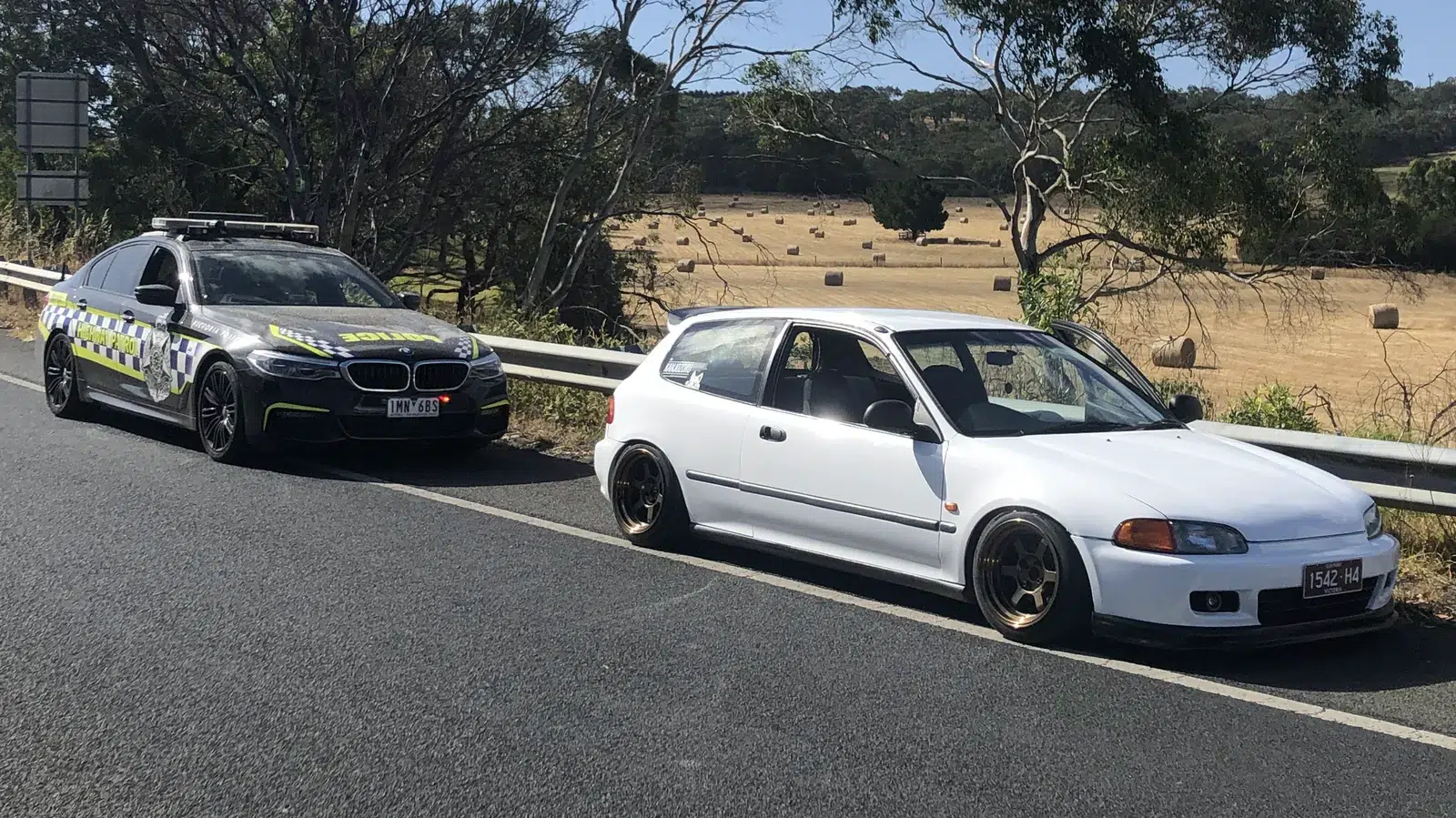

A defect notice usually turns up on the side of the road: a sticker on the windscreen, a list of faults and a deadline you didn’t plan for. What happens next depends on where your car is registered. How long you get to fix it, whether you can still drive it, who signs it off and what it costs are all different from state to state.
Here’s how it works in every state and territory, taken from each government’s own pages, and what to do so a defect doesn’t turn into a suspended rego. I’ve been on the receiving end too. My EG Civic picked up four defects in one stop, so further down I go through each one, the rule behind it and how I cleared it.
What a defect notice actually means
It isn’t a fine. Queensland’s transport department puts it plainly: a defect notice is not a fine. It’s an order to fix the car and then prove you’ve fixed it.
Police can issue them everywhere, and in most states transport inspectors can too. The notice lists what’s wrong, gives you a deadline, tells you whether you can keep driving in the meantime, and explains how to clear it. A label usually goes on the car as well. Leave it there: removing or damaging it is an offence in states including Western Australia and Queensland.

Several states grade their notices. Victoria uses major, minor and formal warning. The ACT has warning, minor and major notices, and South Australia has major and minor notices plus a written warning. A major notice usually means the car is off the road until it’s fixed.
Defect notice rules by state at a glance
| State | Time to fix it | Who clears it | Cost to clear |
|---|---|---|---|
| NSW | Due date on the notice | Some repairs need an authorised inspector | Not published on the defect pages |
| VIC | 28 days, or rego is suspended | Roadworthy certificate or VicRoads inspection | $57.30 with inspection, $22.10 without |
| QLD | Date on the notice | May need a TMR customer service centre inspection | $57.40 plus $37.20 booking ($116.75 plus booking for an unsafe vehicle notice) |
| WA | Full inspection within 14 days of the expiry date | Authorised Inspection Station | Set by the inspection station |
| SA | Time set on the notice | Police (some minor defects) or a DIT inspection | $241 first DIT inspection, $136 re-inspection |
| TAS | Deadline on the notice | As instructed on the notice | Not published |
| ACT | 14 days unless the notice says otherwise | Full inspection where the notice says | Not published on the defect pages |
| NT | Not published | Transport inspector, full roadworthy inspection | $70.40 prescribed inspection fee |
NSW defect notice rules
NSW Police can stop and inspect your car at any time, and issue a defect notice if it isn’t safe to drive. The examples the NSW Government gives will be familiar to anyone in the modified scene: excessive noise, oil leaks or smoke, unsafe or non-compliant bull bars, and badly fitted accessories like winch and spotlight mounts.
You must repair the car by the due date on the notice. Some repairs have to be cleared by an authorised person, such as a vehicle inspector. Miss the due date and your registration can be suspended.
Rego coming up with a defect still open? To renew with outstanding defects, the car needs the specialist inspection, all defects cleared, and a new safety check (pink slip) dated after the defect notice. Lost the notice itself? Transport for NSW has a declaration form for that, and it needs a full inspection at an authorised station.
Victoria defect notice rules
Victoria Police, the Department of Transport and Planning’s vehicle standards team, Safe Transport Victoria and interstate inspectors can all issue notices. VicRoads lists four types: major (faulty brakes or worn-out tyres, for example), minor (broken lights or small windscreen cracks), formal warnings, and self-clearing notices, which are for heavy vehicles only.
Every light vehicle notice has a “prohibit” time. After it passes, the car can’t be driven and has to be towed or trailered. Once it’s repaired, and as long as the rego isn’t suspended, you can only drive it to a licensed vehicle tester, to a VicRoads Customer Service Centre for inspection or clearance, or home after testing.
The deadline that matters is 28 days from the issue date. Clear it by then or the registration is suspended. The notice tells you whether you need a roadworthy certificate (valid for 30 days) or a VicRoads inspection, which needs no appointment but does need the notice and your repair receipts. A formal warning needs no inspection at all.
Clearing it costs $57.30 with a VicRoads inspection or $22.10 without. One catch for exhaust builds: an EPA vehicle testing notice, such as one for noise, can’t be cleared by VicRoads at all. That goes through the EPA.
Queensland defect notice rules
A police officer or transport inspector can issue one, to the owner or the driver. Say you were driving someone else’s car, you have to pass it on to the owner as soon as practicable.
If the defect is dangerous, the car can be ordered off the road on the spot and a label stuck somewhere prominent. If it isn’t, you may be allowed to drive it to a specified place, like home or a repairer. The notice can also set conditions, such as no driving in the wet with dodgy wipers. Queensland lists a non-compliant modification as one of the reasons a car can be defected.
Fix it by the date on the notice, or ask the officer who issued it for an extension. The car may then need an inspection at a transport and motoring customer service centre. As at 1 July 2026 that’s $57.40 for most notices, or $116.75 for an unsafe vehicle defect notice, plus a $37.20 booking fee either way. Ignore it and you’re looking at an on-the-spot fine, an order for a full inspection, or action to cancel the registration.
WA defect notice (yellow sticker) rules
In WA it’s a yellow sticker or work order, issued by WA Police, transport and Main Roads officers, or Consumer Protection officers for cars on dealer lots. The car can’t be driven on WA roads after the expiry date on the notice.
You need to fix it and get a full inspection at an Authorised Inspection Station within 14 days of that expiry date. Full means full: the whole car is checked, not just the faults on the sticker, and a new work order can be issued on the spot. You book and pay the inspection station directly.

If the car is licensed and fixed, you can drive it to the inspection station. After the expiry date, it can only go by the shortest practical route from the repairer straight to the nearest station. If it isn’t fixed by then, it goes on a tow truck or trailer. Leave it longer and it escalates: a first and final notice after 14 days, then a notice to return your plates after 28 days, with no licence renewal until the defect is cleared.
SA defect notice rules
SA Police and Department for Infrastructure and Transport (DIT) inspectors issue them. The SA Law Handbook explains the split: a major notice for imminent and serious safety risks, a minor notice for everything else, and a formal written warning for faults that aren’t a safety risk. A “Lift Tow” label means the car can’t be driven until it’s repaired.
The officer writes on the notice how long you can keep using the car. After that, it can only go to and from repairs or inspection. Police may clear minor defects like lights, tyres, horns or wipers, but not notices that have been directed to DIT. Those need a booked DIT inspection, which in metro Adelaide means Regency Park or Lonsdale. Turn up with a clean car, because excessively dirty vehicles aren’t inspected.
A defected vehicle inspection is $241 the first time and $136 for each re-inspection, including a $31 booking fee. Driving or selling a defected car against the notice can bring a fine of up to $1,250 and 3 demerit points, according to the Law Handbook.
SA is also the strictest state on engine mods. Non-standard blow-off valves, turbo timers, boost controllers, turbos, engine management systems and engine internals aren’t permitted unless they’ve been approved, so a defect for any of those isn’t a quick fix.
Tasmania defect notice rules
A police officer or a Transport Safety and Investigations Officer can issue a defect notice in Tasmania. Most of the detail lives on the notice itself: what needs fixing, the deadline, whether you can use the car before then, and any conditions on that use.
To keep using the car, fix the problems and follow the instructions to have the notice cleared. If you don’t want to keep it on the road, you can surrender the plates at Service Tasmania instead. After the deadline, the car can’t be used unless the notice is cleared. The Registrar follows up uncleared notices and sends a letter before suspending or cancelling the registration, and you can be fined or prosecuted for not complying. You can see any active defects on your vehicle through myServiceTas.
ACT defect notice rules
ACT Government vehicle inspectors, the AFP and the heavy vehicle regulator can all issue notices. Access Canberra uses three levels for cars: a warning for defects that aren’t a safety risk, a minor notice for defects that could become one, and a major notice for a serious safety risk. “Illegal modifications” is on its list of reasons.
You have 14 days to clear it unless the notice says otherwise. After that, the timeline is set: a letter on day 14, registration suspended on day 35, and cancelled on day 56, at which point the plates go back and there’s no rego refund. While the car is still registered you can drive it to repairs or inspections, unless the notice says otherwise.
Cars get a full inspection, at the place the notice names. If it names the Motor Vehicle Inspection Station in Hume, an inspection anywhere else won’t be accepted. Modified vehicles and street rods can only be inspected at Hume anyway. Any new defects found at the inspection don’t get you extra time, and once it passes you clear it at an Access Canberra Service Centre.
NT defect notice rules
Transport inspectors and police issue defect notices in the Territory. Under the NT’s inspection rules (updated February 2026), a defect notice can only be cleared by a transport inspector after a full roadworthy inspection. You pay before the inspection, and the prescribed light vehicle inspection fee is $70.40.
The NT doesn’t publish a standard deadline or driving rules for defected cars online, so follow the notice and ask the Motor Vehicle Registry if anything on it isn’t clear.
Got defected interstate?
The states share defect notices. According to WA’s transport department, a notice can be issued or cleared in any Australian jurisdiction, and the home state and the issuing state are both notified. The ACT says the same thing from the other side: it sends the details to the state your car is registered in.
The bit people miss is telling their home state. VicRoads warns that a Victorian car defected interstate can have its registration suspended even after passing an interstate inspection if the cleared paperwork isn’t handed in. If you clear it interstate, get the signed-off notice to your home registry as soon as you’re back.
Modified car? This is where it gets expensive
For a stock car, clearing a defect is usually a new globe or a tyre. For a modified car, the fix can be going back to standard or getting the mod engineered, which takes a lot longer than 14 or 28 days. That’s why it pays to know your mods are legal before a highway patrol officer decides for you.
What got my EG Civic defected, and the rule behind each one
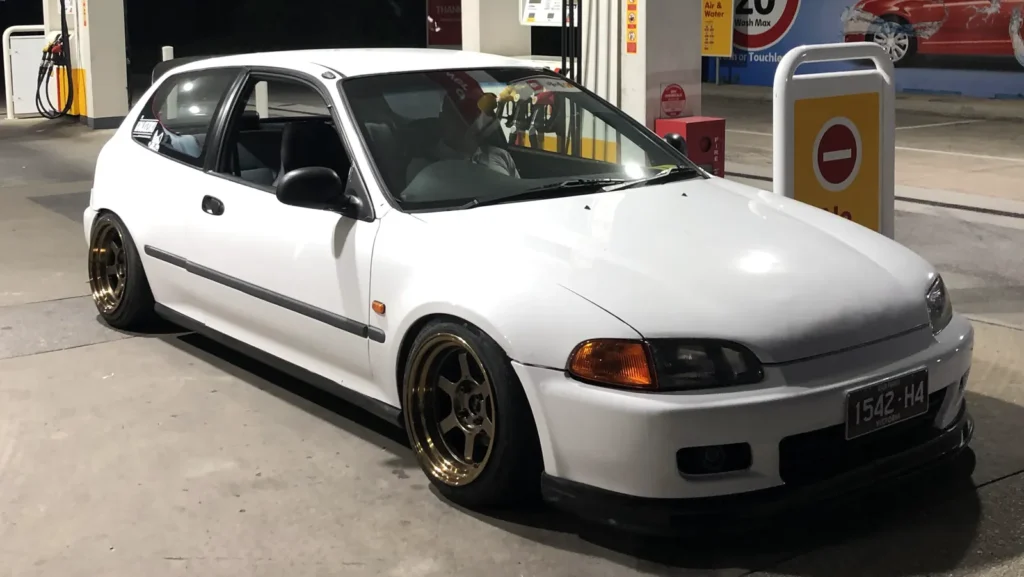
New Year’s Eve 2019, and Victoria Police pulled over my EG Civic hatch. It left with a defect notice for four things: it was too low, the tyres were stretched, it had a quick-release steering wheel and there was no H pattern on the gear knob. A $413 infringement notice came with it, for using a vehicle that didn’t comply with the standards of registration.
For the record, the officers were lovely and respectful the whole way through, and I was the same with them.
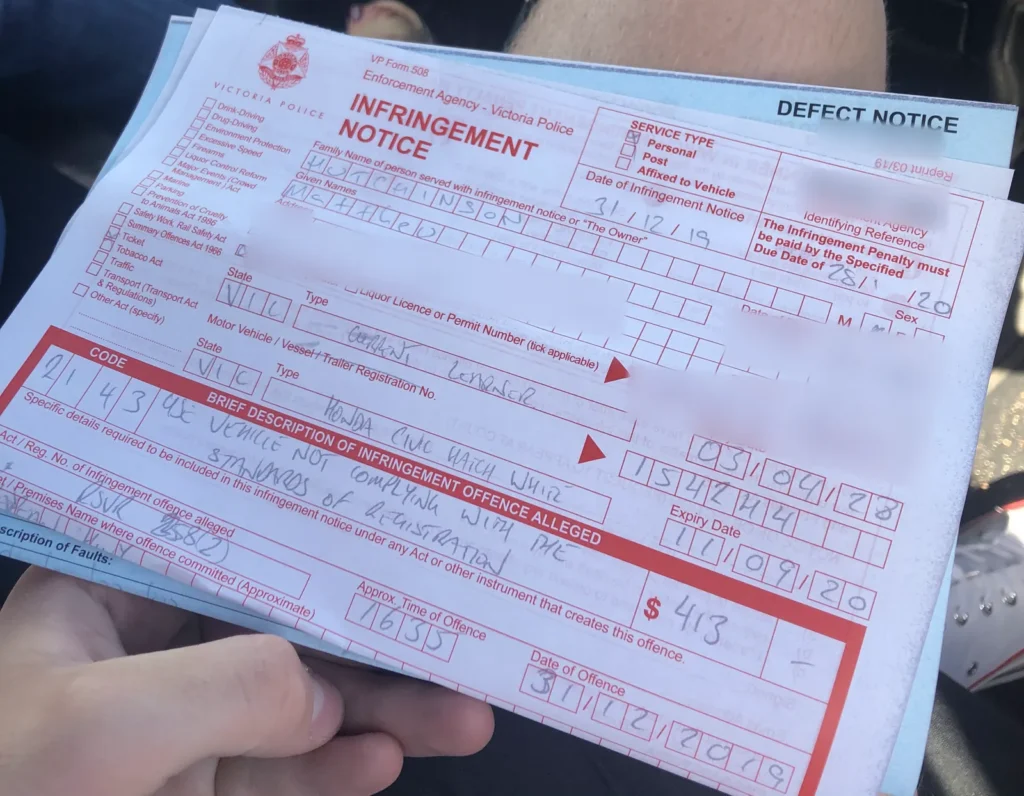
Each of the four comes back to a written rule. Victoria’s modification guide, VSI 8, builds on the national code for modified cars, VSB 14, so most of this applies well beyond Victoria.
How low is too low?
In Victoria, 100mm of ground clearance is the floor. That’s the figure VSI 8 works to alongside ADR 43. Lowering without engineering is also capped at a third of the original suspension travel under VSB 14 Section LS, as Tasmania’s inspection manual sets out. The state-by-state detail is in our guide to how low you can legally lower your car.
Are stretched tyres legal?
Not on the road. VicRoads’ roadworthiness standard, VSI 26 (March 2023), says tyre sizes must be compatible with rim sizes as set out by the Tyre and Rim Association. A stretch puts the tyre on a rim wider than its approved range, so it fails on paper however good it looks.
Tyre makers publish the approved rim widths for each size, so check that before you order. On a wide wheel, expect the legal answer to be a wider tyre.
Are quick-release steering wheels legal?
No grey area here. The national code’s Section LS says removable steering wheels must not be fitted. An aftermarket wheel on a fixed boss kit is a different story, but on a car built to ADR 10 the replacement has to meet ADR 10 too, as Queensland’s TMR spells out. Save the quick release for the track car.
Do you need an H pattern on the gear knob?
This is the one people argue about. The federal Department of Infrastructure told Drive in 2024 that ADR 42 doesn’t mandate gear shift patterns, and transport departments in NSW, Queensland and SA said a missing H sticker isn’t a defect on its own. In Victoria, Drive found it comes down to the officer’s judgement under the roadworthiness rules.
That judgement went against me. A shift-pattern sticker or a knob with the pattern on it costs next to nothing, which makes it the cheapest item on this list to avoid.
How I cleared it: back to stock
I took the simple route and put the car back to stock. The factory suspension, wheels and steering wheel had come with the car when I bought it, so all three went back on, and an H pattern sticker went on just below the shifter. Then it needed another roadworthy.
I reckon I got off lightly that day. The $413 wasn’t the real cost. That was the time spent on parts of the car I had no interest in working on, and the fuss of getting it through another roadworthy.
The lesson I took from it: modify to your taste, but keep it inside the legal limits, or at least inside what Victoria Police will accept. It’s pretty simple, and far cheaper than doing the job twice.
Defected for a mod: back to stock or get it engineered?
If the stock parts are sitting in your shed, going back to standard is almost always the quicker way to clear a notice. Engineering is the other road, and in Victoria that means a VASS approval certificate. It suits a mod you want to keep and that can be certified. It does nothing for a mod the rules ban outright.
VASS signatories are engineers authorised to certify modified vehicles in Victoria. Once satisfied, they issue an approval certificate and fit a blue modification plate, and a light vehicle certificate is valid for 30 days. VicRoads doesn’t set what signatories charge, so talk to one and get a price before you spend money on parts.
The cheapest insurance against all of this is free: keep the stock parts. Mine came with the car, and they’re the reason clearing the notice was a parts swap rather than a parts hunt against a 28-day deadline.
Our free car modification laws checker shows the rules for your state and links to the source. For the common ones, there’s more detail on how low you can legally go, window tint limits by state, exhaust noise laws and what P-platers can modify.
How to deal with a defect notice without it getting worse
- Read the whole notice first. The type, the deadline, whether you can drive the car and where you have to get it cleared are all on there.
- Fix everything on it, and keep the receipts. VicRoads asks for them, and they’re handy anywhere else.
- Expect the whole car to be checked. WA and the ACT inspect the full car, not just the listed faults, so sort out anything else that’s marginal before you go.
- Don’t peel the sticker off. It comes off once the notice is cleared, not before.
- Can’t make the deadline? In Queensland, ask the issuing officer for an extension. In WA and Tasmania, surrendering the plates is an option. Doing nothing is the option that ends with your rego suspended or cancelled.
General information only. Defect notice rules, fees and timeframes change, and the instructions on your notice take priority over anything here. Check with your state’s police or road authority if you’re unsure. Header image: Matt Hutchinson.



